AION 2 Crafting Guide: Professions & Gathering
AION 2 Crafting Guide: Professions, Gathering, and Efficient Progression
Crafting in AION 2 is an important part of character progression, whether you want to create equipment, prepare consumables, improve your gear, or earn Kina through the player economy. However, the crafting system involves more than selecting a recipe and collecting a few materials. You need to develop individual professions, gather resources efficiently, understand crafting success rates, and decide which materials are worth your time.
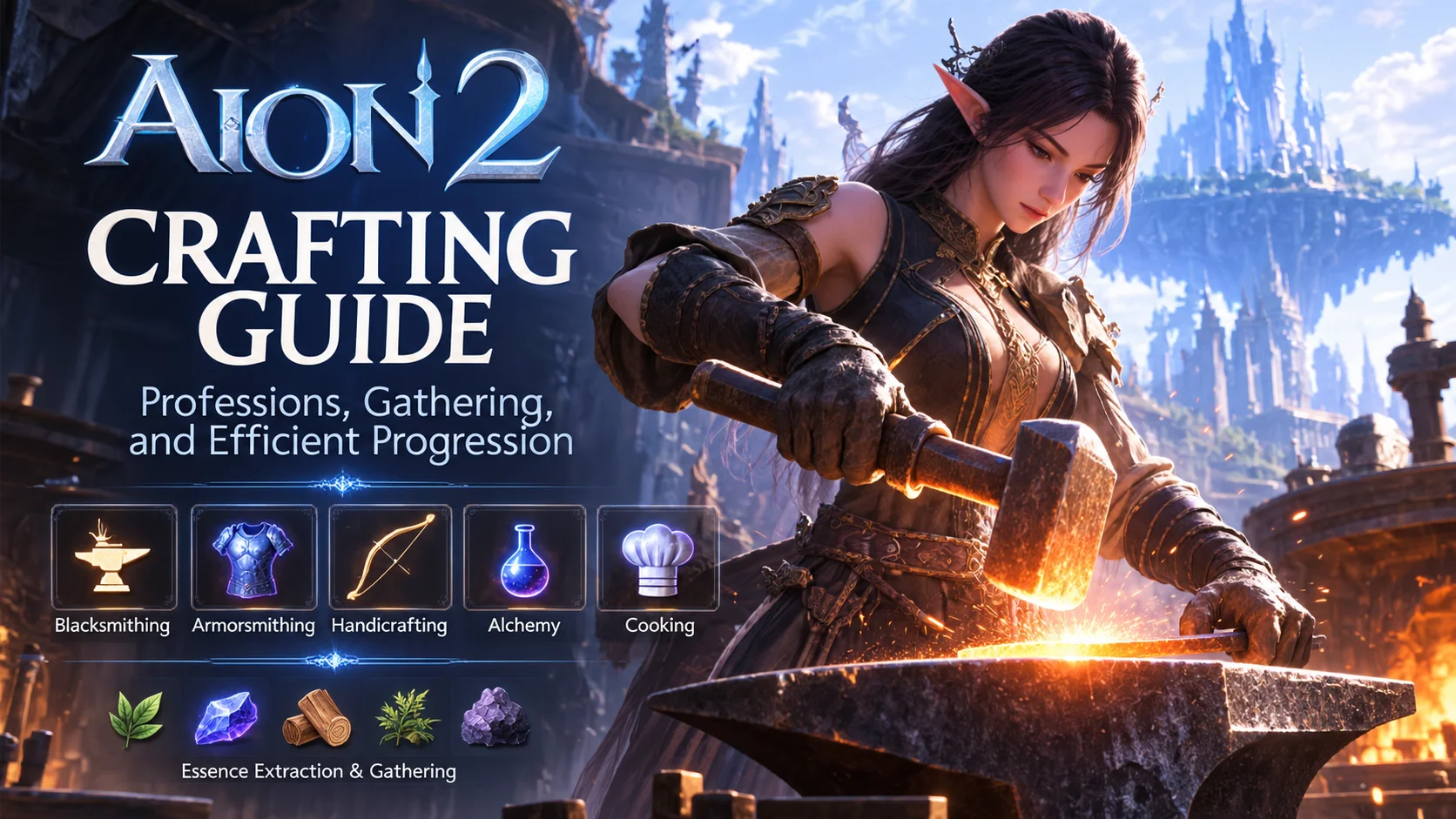
AION 2 has five crafting professions: Blacksmithing, Armorsmithing, Handicrafting, Alchemy, and Cooking. Gathering is handled through a separate system called Essence Extraction, which covers six types of resources. Both systems have their own progression mechanics, and understanding how they work together can help you avoid wasting valuable materials.
This AION 2 crafting guide explains every profession, how to level your skills, where to obtain materials, and how to make smarter crafting decisions. If your main goal is improving your character rather than handling every progression task yourself, you can also explore the AION 2 boosting services available at misti.services.
How Crafting Works in AION 2
The crafting system allows you to turn gathered resources and vendor materials into weapons, armor, accessories, consumables, and other useful items. Each profession has its own proficiency level, recipe requirements, and progression path. Increasing one profession does not automatically improve the others, so you need to decide where to invest your time.
Most recipes require a combination of materials collected in the world and supplementary ingredients purchased from profession vendors. Advanced recipes may also require refined materials, higher-quality resources, monster drops, or items obtained through PvE activities.
Crafting uses a Success Gauge and a Failure Gauge. During an attempt, both gauges can increase in random increments. If the Success Gauge reaches its target first, the craft succeeds. If the Failure Gauge fills first, the attempt fails.
This matters because crafting is not completely predictable. Even a recipe you can comfortably afford may consume your materials without producing the desired item. Your profession proficiency influences the probability of success, so developing your skills can make crafting more reliable over time.
You can inspect the expected crafting chance before starting an attempt. This is especially useful when working with expensive materials or recipes you intend to repeat several times.
Claim your first-visit discount now
All Five AION 2 Crafting Professions Explained
Choosing a profession should depend on your class, progression goals, available resources, and interest in the player economy. Some professions focus on equipment, while others are more useful for consumables and character preparation.
Profession | Main Items | Best Use |
|---|---|---|
Blacksmithing | Greatswords, longswords, daggers, maces, guards, and crafting materials | Weapon and material crafting |
Armorsmithing | Chest armor, leg armor, helms, pauldrons, gloves, boots, cloaks, and crafting materials | Armor progression |
Handicrafting | Bows, staves, necklaces, earrings, rings, bracelets, and crafting materials | Weapons and accessories |
Alchemy | Spellbooks, orbs, potions, serums, scrolls, Manastones, Soulstones, and crafting materials | Consumables and magical equipment |
Cooking | Food and cooking materials, including seasonings | Consumables and character preparation |
Blacksmithing
Blacksmithing focuses on weapons and related materials. It is a natural choice for players interested in crafting melee weapons or processing ore into components used by more advanced recipes.
Many crafting chains begin with a raw resource and a supplementary reagent bought from a vendor. For example, an early Orichalcum Ingot recipe uses Orichalcum Ore together with Orichalcum Solvent. The resulting ingot can then serve as an ingredient for more advanced equipment recipes.
Before investing heavily in Blacksmithing, check whether the weapons or materials you want are actually useful for your current progression. Crafting can provide valuable alternatives, but it does not automatically make every piece of equipment better than gear earned from quests, dungeons, or other PvE activities.


Armorsmithing
Armorsmithing is the main profession for crafting armor pieces. It covers several equipment slots, including chest pieces, helmets, gloves, boots, and other armor components.
It can be useful when you need a particular defensive upgrade or want to explore equipment crafting rather than relying entirely on drops. However, the value of a crafted item depends on its stats, grade, enhancement potential, and the materials required to produce it.
If you are deciding which equipment deserves your resources, read the AION 2 Gearing Guide. It covers the wider progression process and helps put crafting into the context of your overall gear development.
Handicrafting
Handicrafting produces bows, staves, and accessories such as rings, necklaces, earrings, and bracelets. These items can make the profession relevant to players looking for equipment beyond traditional armor and melee weapons.
Accessories deserve particular attention because a useful upgrade may improve your character without requiring a complete replacement of your armor set. As with other professions, compare the item's benefits with the materials and time needed to craft it.
A recipe is worth pursuing when the finished item supports your build and offers a meaningful improvement over your current equipment. Simply crafting something because you have reached the required proficiency is not a particularly efficient use of resources.
Alchemy
Alchemy covers several important consumables and magical items, including potions, serums, scrolls, spellbooks, orbs, Manastones, and Soulstones.
Its usefulness depends on the recipes available at your current proficiency and the needs of your character. Consumables can support regular PvE progression, while other products may contribute to equipment development.
Alchemy can also be interesting for players who pay attention to the Market. Demand for particular items changes as players progress and consume resources. Before crafting products specifically to sell, compare their current selling prices with the cost of the required ingredients.
Cooking
Cooking produces food and related consumables. It is worth considering if you regularly use food during PvE activities or want to prepare useful items for your own character.
The profession also uses cooking ingredients gathered through Essence Extraction. This gives Cooking a direct connection to the gathering system and provides another reason to collect resources while exploring the world.
You do not need to master all five professions immediately. Start with the one that best supports your current goals, then expand into other crafting options as your character and resource supply develop.
Essence Extraction: How Gathering Works
In AION 2, gathering is called Essence Extraction. Rather than having separate professions for activities such as mining and herbalism, the system combines resource gathering under one proficiency progression.
There are six resource categories:
Resource Type | What You Gather |
|---|---|
Ore | Metallic resources used in crafting |
Gems | Gem materials for relevant recipes |
Logs | Wood-based crafting resources |
Herbs | Herbal materials |
Cooking Ingredients | Materials used by Cooking |
Odyle | A specialized resource used in relevant recipes and progression |
Your Essence Extraction proficiency increases as you gather resources from the world. You can develop the shared gathering skills to improve extraction attempts, while specialized skills let you focus on particular resource categories.
Gathering nodes can be used multiple times before they are depleted. Each attempt can succeed or fail, and the corresponding gauge determines the result. A failed attempt does not necessarily end the interaction immediately, but it can reduce the number of successful extractions you receive from a node.
Because gathering itself takes time, improving your extraction skills can make a noticeable difference to how efficiently you collect materials over long sessions.
Common Essence Extraction Skills
The shared Essence Extraction skill tree has three main skills.
Proficient Handling improves the amount added to your Success Gauge when an extraction succeeds. Higher levels make successful attempts more effective.
Delicate Touch reduces how much the Failure Gauge increases when an extraction fails. This helps reduce the impact of unsuccessful attempts.
Lady Luck gives you a chance to increase the Success Gauge by a much larger amount, making particularly favorable extraction results possible.
Each Essence Extraction level awards a common skill point. Higher ranks of these skills require more points, so you cannot necessarily maximize every option immediately.
For general gathering efficiency, Proficient Handling and Delicate Touch are useful starting priorities because they directly affect the success and failure mechanics. You can invest more heavily in Lady Luck as you develop your preferred setup.
The right balance depends on your goals. Players who gather materials constantly may prefer a setup designed for reliable extraction, while those who want to specialize in a particular resource should also consider the available specialty skills.
Specialty Skills and Resource Specialization
Each of the six resource categories has its own group of specialty skills. The structure is similar across categories, although the resources affected by each branch differ.
Specialty Skill | Main Benefit |
|---|---|
Seeker | Reveals the relevant resource type on the minimap |
Plentiful Harvest | Provides a chance to obtain additional materials from a successful extraction |
Appraiser | Provides a chance to reroll the grade of an extracted resource |
Plentiful Harvest and Appraiser can be especially useful when you gather frequently or want to obtain more value from each resource node. Higher skill levels can improve the potential benefits of these specializations.
However, specialty points are limited. You receive them at specific Essence Extraction milestones, and the total available points are not enough to fully maximize all six resource categories at once.
This makes specialization an important decision. Instead of spreading points across every type of material without a clear goal, consider which resources your preferred recipes consume most often. If you mainly craft weapons, armor, or accessories, prioritize the categories that support those recipes. If Cooking is your focus, cooking ingredients may deserve more attention.
You can reset your Essence Extraction skill allocation for a cost. The current system described in this guide lists a fee of 50,000 Kina, so avoid treating specialization changes as completely free. Check the in-game interface before resetting because costs and mechanics can change with updates.
Understanding Resource Quality
Not all gathered resources have the same quality. Ore, gems, logs, and Odyle can appear in different grades, with higher-quality variants used by certain recipes and more advanced crafting chains.
For example, Odyle has several forms, including Odyle, Fine Odyle, Pure Odyle, and Radiant Odyle. Higher-grade materials can become particularly important when you reach recipes that require refined or specialized ingredients.
This is where Appraiser can be useful, since it gives you a chance to reroll the grade of an extracted resource. Even so, do not assume that the highest-grade material is always the most profitable. Its value depends on whether other players need it and what they are willing to pay.
For more information about making currency through different activities, see our AION 2 Kinah Farming Guide.
How to Increase Crafting Proficiency
Each crafting profession has its own proficiency level, and each one must be leveled separately. Progress in Blacksmithing will not increase your Alchemy or Cooking proficiency.
Crafting progression is divided into two ranks:
Rank | Proficiency Levels | What You Need to Do |
|---|---|---|
Novice | 1 to 50 | Craft items using available Novice recipes |
Professional | 51 to 100 | Complete the promotion requirement at level 50, then continue progressing |
At Novice level 50, you must complete the relevant promotion before continuing into the Professional rank. The same overall progression structure applies to each of the five crafting professions.
Higher proficiency unlocks recipes with greater requirements and can improve your success chance when crafting recipes below your current level. This means profession leveling may continue to be useful even after you have unlocked a particular recipe.
The important thing is to avoid spending expensive materials on recipes that provide little practical benefit. Choose items that use accessible ingredients, contribute meaningful proficiency progress, or produce something you actually intend to use.
Failed crafts also provide profession experience, even though the required materials are consumed. This means an unsuccessful attempt is not entirely wasted from a progression perspective, but frequent failures can still make expensive recipes a poor leveling choice.
Where to Find Crafting Stations and Materials
Crafting is performed at specific stations in faction cities and settlements. Opening the crafting menu alone is not enough to complete a recipe. You need to visit the appropriate station and interact with it.
The available station locations include the following:
Faction | Crafting Areas |
|---|---|
Elyos | Dawn Legion Base and Zumion Village in Verteron |
Asmodians | Safe Haven and Nornir Assembly in Altgard |
Profession merchants can be found near the crafting areas. They sell supplementary materials required by recipes, including solvents, oils, powders, seasonings, and other reagents.
These vendor ingredients are an important part of the crafting economy. A recipe may require both materials collected in the world and items purchased from a merchant, so remember to include both when calculating the total cost.
Before travelling to a crafting station, review your recipe requirements and check that you have enough of every ingredient. This is particularly useful when you plan to craft several items in one session.
Crafting quantities can be adjusted through the interface, allowing you to make multiple items in a single batch when you have sufficient resources. Batch crafting is convenient for routine recipes, but check the costs carefully before committing a large amount of materials.
Crafting Success Rates and COMBO Crafting
One of the most important mechanics to understand is that crafting success is affected by both the recipe and your current proficiency.
Each recipe has its own proficiency requirement and Success and Failure Gauge behavior. Being above the required proficiency generally improves your expected success chance, but the increase is not perfectly linear. Gaining several proficiency levels does not guarantee the same increase in probability for every recipe.
Before beginning a valuable craft, open the Crafting Chance window and review the Expected Probability information. It provides a better indication of your chances than simply looking at the recipe requirement.
Keep in mind that a failed craft consumes its materials. If you are working with expensive resources, even a small improvement in success probability may be worth considering before you proceed.
You should also avoid crafting in dangerous areas. If combat interrupts the process, the attempt can be canceled and treated as a failure, consuming the materials without producing the intended item.
What Is COMBO Crafting?
Certain recipes support an additional mechanic called COMBO crafting. It can only be triggered after the ordinary craft succeeds, and it has its own activation probability.
This means that the normal crafting chance and the COMBO chance should be evaluated separately. A successful basic craft does not guarantee that the additional crafting step will activate.
COMBO crafting can be particularly relevant to equipment recipes because it may produce an improved version of an item. Certain crafting chains also use improved results as ingredients for later recipes, which makes them important for advanced progression.
When working toward an upgraded weapon or armor piece, do not look only at the cost of a single attempt. Consider the entire recipe chain and the possibility that you may need multiple attempts before obtaining the result required for the next stage.
Crafted Equipment Quality and Upgraded Results
Crafted equipment progresses through several item grades. In the current Global crafting progression described here, Common, Rare, Epic, and Unique are the main grades relevant to crafted equipment.
Some recipes can also produce Splendent versions through the COMBO system. These are improved crafting results rather than a separate grade of their own, and they can play an important role in advanced equipment chains.
A simplified progression may begin with an ordinary Common-quality weapon, advance into Rare-quality versions, and eventually lead to Epic or Unique equipment through later recipes and improved crafting results.
This system rewards planning. If an advanced recipe requires a particular intermediate item, you may need to craft the earlier version and obtain an improved result before continuing. A failed basic craft or an unsuccessful COMBO attempt can therefore affect your total material requirements.
Recipe details and grade progression may change with game updates, so check the current in-game recipe information before committing rare materials to a long crafting chain.
For a broader look at equipment improvements and character development, explore our AION 2 Combat Power Guide and AION 2 Gear Score Guide.
Can You Make Kina With Crafting?
Crafting can be a useful source of Kina, but reaching a high profession level does not automatically make you profitable. Your results depend on material costs, the selling price of finished items, Market demand, and the resources you already have available.
Before crafting something specifically for sale, compare the total cost of producing it against the price buyers are currently paying. Include gathered materials in your calculations, even when you collected them yourself. Gathering still consumes time, and using materials for one recipe means you cannot use those resources elsewhere.
Vendor ingredients, failed attempts, and the possibility of needing multiple COMBO crafts can all affect the final cost. An item that looks valuable may produce little profit if its recipe is expensive or if other players are selling the same product for less.
There are situations where crafting materials you cannot readily sell may be more useful when converted into a tradable finished product. However, this depends on the relevant material restrictions and whether the resulting item can actually be traded.
To identify profitable crafting opportunities, keep an eye on the Market and look for items with consistent demand. Avoid relying on an old list of valuable recipes without checking current prices. As more players unlock advanced content, demand for particular materials and finished items can change significantly.
You can combine crafting with gathering to reduce the need to purchase every ingredient. Collect materials while completing quests or travelling between objectives, then use them in recipes that support your character or have a reasonable market value.
For more ways to earn currency through quests, dungeons, gathering, and other activities, read our AION 2 Kinah Farming Guide.
Practical Tips for Faster AION 2 Crafting Progression
The best crafting strategy is one that supports your character without consuming all your time and resources. A few practical habits can make the process more efficient.
Choose a profession with a clear purpose. Start with the items you want to produce rather than trying to level every profession simultaneously. A specific goal helps you determine which recipes, materials, and gathering skills deserve your attention.
Gather while you progress. Collect resources when you encounter them during questing and exploration. This helps build a material supply without requiring every play session to focus exclusively on gathering. Our AION 2 Leveling Guide covers progression through the early game, which can help you plan your time more effectively.
Improve your gathering reliability. Invest in shared Essence Extraction skills that suit your needs, then specialize in the resource categories you use most frequently. Gathering more efficiently can reduce how much time you spend collecting ingredients for your recipes.
Check the recipe before crafting. Review the proficiency requirement, required materials, and expected success probability. This is particularly important for expensive equipment and recipes that require intermediate crafting results.
Promote at level 50. Remember that each crafting profession requires its own promotion before progressing beyond Novice level 50. Plan for this milestone instead of assuming proficiency will automatically continue to 100.
Compare Market prices before selling. Do not assume that raw materials are always less valuable than the finished item, or that an advanced recipe guarantees a profit. Compare the alternatives before using your resources.
Keep crafting away from danger. Crafting interruptions can turn an otherwise affordable attempt into an unnecessary loss. Use safe crafting areas whenever possible.
Connect crafting with your overall progression. Gear, character level, and other systems all influence how you use your resources. You can also consult the AION 2 Daily and Weekly Checklist to organize recurring activities alongside your crafting goals.
Frequently Asked Questions
What is the best crafting profession in AION 2?
There is no single best profession for every player. Blacksmithing focuses on weapons and related materials, Armorsmithing produces armor, Handicrafting covers bows, staves, and accessories, Alchemy provides consumables and magical items, and Cooking creates food. Choose based on your class, equipment needs, and preferred activities.
How many crafting professions are there in AION 2?
AION 2 has five main crafting professions: Blacksmithing, Armorsmithing, Handicrafting, Alchemy, and Cooking. Each profession has a separate proficiency level and must be developed independently.
What is Essence Extraction in AION 2?
Essence Extraction is the game's gathering system. It covers six resource categories: ore, gems, logs, herbs, cooking ingredients, and Odyle. You gain proficiency by gathering resources and can invest points in common and specialized skills to improve your results.
How do you level crafting to 100 in AION 2?
Each profession progresses through Novice levels 1 to 50 and Professional levels 51 to 100. At Novice level 50, complete the appropriate promotion before continuing. You then gain further proficiency by crafting recipes from that profession.
Can crafting fail in AION 2?
Yes. Crafting uses Success and Failure Gauges, and the outcome depends on which gauge reaches its target first. A failed attempt still consumes the required materials, although it also provides profession experience. Raising your proficiency above a recipe's requirement generally improves the expected success chance.
Does COMBO crafting guarantee a better item?
No. COMBO crafting is an additional chance that can occur after a successful normal craft on supported recipes. It has a separate activation probability, so you should account for the possibility of additional attempts when planning an advanced crafting chain.
Is crafting a good way to make Kina?
It can be, but profitability depends on the recipe, the cost of ingredients, the likelihood of obtaining the desired result, and current Market demand. Compare the total production cost with the selling price before crafting items solely for profit.
Should I level gathering and crafting together?
Usually, this is a practical approach. Gathering supplies materials for your professions, while crafting turns those materials into equipment and other products. Developing both systems around a specific goal can reduce your reliance on Market purchases, although buying materials may still be worthwhile when your time is limited.
Final Thoughts
Crafting in AION 2 gives you another way to develop your character, create useful items, and participate in the player economy. The five professions each serve different purposes, while Essence Extraction provides the materials required for much of the crafting process.
The most efficient approach is to select a profession that matches your goals, improve your gathering skills, and learn how proficiency affects crafting success. Pay attention to material quality, vendor costs, and COMBO crafting when working on more advanced recipes. If you intend to sell your products, check the Market rather than assuming every high-level recipe is profitable.
You do not need to master the entire crafting system at once. Start with the materials and recipes that provide the greatest benefit to your character, then expand as your proficiency and resources grow.
If you would rather spend more time progressing through AION 2 and less time managing repetitive activities, explore the AION 2 services at misti.services for available leveling, Kinah, dungeon, and other progression options.