AION 2 Skill Progression Guide: Explained by MMO Players
AION 2 Skill Progression Guide: Skill Points, Daevanion, Arcana & Stigmas
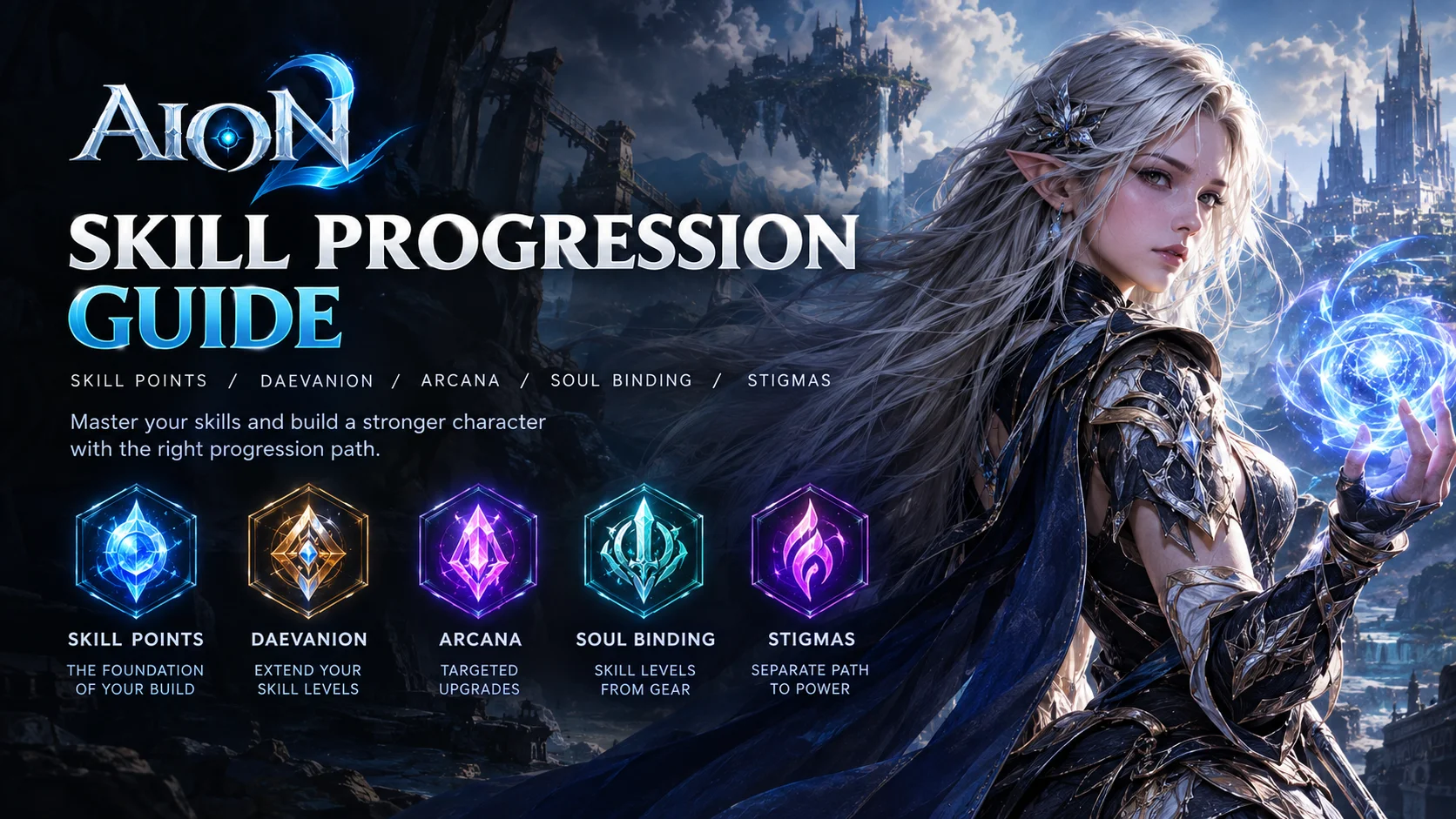
AION 2 does not use a single system for improving your skills. Active and Passive Skills begin with Skill Points, but that is only the first stage of progression. Once an ability reaches the normal Skill Point limit, Daevanion Boards, Arcana and Soul Binding become increasingly important. Stigma Skills follow their own progression path and use Stigma Shards instead.
That can make the system look much more complicated than it really is. The important thing is understanding which progression system affects which type of skill, when each one becomes relevant, and where your resources are best spent.
This AION 2 skill progression guide explains Active Skills, Passive Skills, Specialties, Skill Points, Daevanion Boards, Arcana, Soul Binding and Stigma Skills, with a practical upgrade order for both new players and endgame characters.
AION 2 Skill Progression at a Glance
System | Main Purpose |
|---|---|
Skill Points | Raise Active and Passive Skills through the early levels |
Daevanion Boards | Add additional levels to Active and Passive Skills |
Arcana | Increase specific Active or Passive Skills |
Soul Binding | Add skill levels through equipment traits |
Stigma Shards | Upgrade Stigma Skills separately |
Skill Specialties | Add additional effects and utility to Active Skills |
Active and Passive Skills can ultimately reach level 20 through several overlapping systems. Skill Points take the initial progression up to level 10, the first Daevanion Boards can add additional levels, and Arcana plus equipment-based bonuses can push important abilities further. Stigma Skills use a separate progression system.
This is one of the most important things to understand before spending resources. Reaching level 10 on an Active Skill does not mean you have finished upgrading it. The later levels are tied to the wider character progression systems.
Claim your first-visit discount now
Active Skills, Passive Skills and Stigma Skills
AION 2 separates class abilities into three broad categories.
Active Skills are the abilities you directly use during combat. These make up your rotations and are usually the most obvious part of your build.
Passive Skills provide bonuses automatically and do not require you to actively press them during combat. They can improve things such as damage, survivability or other class-specific effects.
Stigma Skills are different from both. They use their own progression system and are not upgraded through normal Skill Points, Daevanion Boards, Arcana or Soul Binding. Instead, Stigma Skills use Stigma Shards.
This separation matters because improving one category does not automatically improve the others.
For a new character, it is usually best to focus first on the Active Skills that define your rotation. Passive Skills should continue to develop alongside them, while Stigmas become more important once your character is established.
How Skill Points Work in AION 2
Skill Points are the starting point for normal skill progression.
You use them to increase Active and Passive Skills, with normal Skill Point progression taking these skills up to level 10. Most players will naturally collect Skill Points through regular character progression, especially through Main Story content and other activities such as Sealed Dungeons.
The mistake is assuming that having enough Skill Points means you should upgrade everything equally.
You should not.
Every class has abilities that contribute much more to the actual performance of the build. One damaging ability might be used constantly, while another skill may be situational. The same applies to passive abilities.
Instead of distributing resources evenly, identify the skills that are responsible for your main damage, healing, defensive utility or control and prioritize those first.
Your AION 2 Leveling Guide 1-45 covers the main progression route and explains how leveling content, dungeons, collectibles and other activities contribute toward a stronger endgame character.

What Happens After Skill Level 10?
This is where AION 2's skill system starts becoming more interesting.
Once an Active or Passive Skill reaches the level available through normal Skill Points, you need to use additional progression systems to continue increasing it.
The first major step is the Daevanion system. The first four Daevanion Boards contain skill-related nodes that can add additional levels to your Active and Passive Skills. According to the current progression model, these boards can provide up to four additional skill levels.
That means your skill progression broadly follows this path:
Skill Points → Daevanion Boards → Arcana and Soul Binding
Stigma Skills are developed separately with Stigma Shards.
Understanding this structure makes the entire system easier to manage because you no longer have to search for one hidden menu where every skill upgrade is stored.
AION 2 Daevanion Boards and Skill Levels
Daevanion Boards are one of the most important permanent progression systems in AION 2.
The first four boards contain dedicated skill nodes. Blue nodes are connected with Active Skills, while green nodes are associated with Passive Skills. Progressing through these boards can add additional levels to your abilities after Skill Points have reached their normal limit.
This makes Daevanion progression valuable even when your equipment is not changing.
Unlike temporary gear upgrades, Daevanion development contributes to the long-term strength of your character. That is one reason why Sealed Dungeons should not be ignored during endgame progression. Their rewards contribute to Daevanion development as well as other useful materials.
Our AION 2 Empyrean Traces, Sealed Dungeons and Strongholds Guide explains how these activities fit into the wider progression system.
Which Daevanion Nodes Should You Prioritize?
There is no universally perfect route because your priorities depend on your class and build.
For an offensive class, skill nodes connected to frequently used damage abilities are usually more valuable than investing heavily into abilities that rarely appear in the rotation.
Healers should prioritize abilities that define their healing and support toolkit. Tanks can place more emphasis on skills that provide survivability, threat generation or defensive utility.
The same principle used for equipment applies here: upgrade the parts of the character that you actually use.
Do not choose a node simply because it is available. Consider what the skill does, how often you use it and whether increasing its level changes an important breakpoint.
AION 2 Skill Specialties
Skill Specialties are one of the reasons Active Skill levels matter so much.
An Active Skill is not simply a button that gets a bigger number every time you increase its level. Certain levels unlock additional Specialty options that change how the ability behaves.
Specialties can increase range, add crowd control, improve cooldowns or change the way an ability interacts with your rotation. This means the correct Specialty can sometimes be more important than a small increase in raw damage.
Current progression information places major Specialty milestones at levels 8, 12, 16 and 20. The first Specialty slot becomes available at level 8, a second slot follows at level 12, the fifth Specialty becomes available at level 16, and the third Specialty slot opens at level 20.
That creates an important distinction between skill level and Specialty progression.
Skill Level 8
Level 8 is the first major Active Skill breakpoint. It unlocks the first group of Specialty choices and gives you your first slot for equipping one of them.
For important abilities, reaching this point can provide more practical value than simply improving a lower-priority skill by several levels.
Skill Level 12
Level 12 adds another Specialty option and opens a second slot.
This is another meaningful breakpoint because you can begin combining two effects on an important ability.
Skill Level 16
Level 16 is a major target for core Active Skills because it unlocks the fifth Specialty option.
For many builds, this is where you begin getting access to the Specialty that most closely matches the intended playstyle.
Skill Level 20
Level 20 is the final major milestone because it opens the third Specialty slot.
That allows an important Active Skill to run three Specialty effects simultaneously, making level 20 especially attractive for abilities that form the core of your build.
You will not realistically max every ability this way. Resources are too limited, so your strongest skills should be prioritized first.
How to Choose the Best Skill Specialties
The strongest Specialty is not necessarily the one with the highest theoretical damage.
A cooldown reduction can outperform a damage modifier if the ability is central to your rotation. Extra range can be more valuable for a ranged build. Crowd control may be essential for PvP even when it does little for a pure PvE setup.
Think about the actual situation where you use the skill.
For PvE, sustained damage and consistent uptime usually matter more than effects designed purely for player control.
For PvP, crowd control, range, mobility and burst interactions can become far more valuable.
This is another reason not to copy a build without understanding it. A recommended Specialty setup may have been created for a specific dungeon, boss, PvP environment or playstyle.
AION 2 Arcana System
Once you have pushed your skills through the early progression stages, Arcana becomes another important source of skill levels.
Arcana Cards can increase specific Active or Passive Skills rather than simply providing a flat bonus to every ability. That makes Arcana much more targeted than the earlier progression systems.
The practical consequence is that Arcana works best when you already know which skills are important to your build.
Getting an Arcana Card that improves a skill you rarely use is much less valuable than getting one that strengthens your primary damage ability, major defensive cooldown or key support skill.
Arcana progression is also tied to Transcendence Dungeons, where Arcana Cards can be obtained from the relevant rewards.
That gives endgame players another reason to include Transcendence content in their weekly progression rather than focusing exclusively on gear.
Should You Chase Rare Arcana Cards?
Rarity alone should not determine whether an Arcana Card is useful.
A rare card that improves an irrelevant skill may contribute less to your build than a lower-rarity card that improves the ability you use constantly.
Start by identifying your core skills. Then look for Arcana options that directly improve those abilities.
Once your core progression is in place, you can begin optimizing around rarer cards and more specialized combinations.
This prevents a common endgame trap where players spend too many resources chasing a theoretically impressive card while their main abilities are still underdeveloped.
Soul Binding and Skill Levels
Gear is another source of skill progression.
Soul Binding can provide ordinary character statistics such as Attack or HP, but certain equipment can also roll skill-level bonuses. Rings and weapons can provide Active Skill bonuses, while other equipment pieces can contribute Passive Skill levels.
This creates another way to reach important skill-level breakpoints without relying entirely on Arcana.
For example, a character may already have an important Active Skill at level 14 through Skill Points and Daevanion progression. A suitable Soul Binding bonus can then help push that skill toward a higher Specialty breakpoint.
The downside is that Soul Binding is part of equipment progression, so the item itself needs to be worth investing in.
Our AION 2 Gearing Guide covers Soul Binding, Enhancement, Manastones, Transfer and Succession in detail.
Should Skill-Level Soul Bindings Be Your Priority?
Not always.
Skill-level traits can be extremely strong when they help you reach an important breakpoint such as 16 or 20. However, general combat stats may provide more overall value when your character is still undergeared.
This is particularly important for Abyss PvP. The current Abyss progression is not based on normalized gear, so raw combat performance and general equipment quality matter significantly.
For that reason, an endgame PvP character should not sacrifice a large amount of useful combat stats just to gain a small skill-level increase.
Skill bonuses work best when they complete an already strong build rather than replacing the foundations of one.
AION 2 Stigma Skills
Stigma Skills have their own progression path.
Each class has its own Stigma Skill options, but you do not have unlimited slots available for using them. Choosing which Stigmas complement your build is therefore an important part of character optimization.
Unlike normal Active and Passive Skills, Stigma Skills do not use Skill Points.
Instead, you upgrade them with Stigma Shards.
The available progression sources include the Abyss Shop as well as other specialized shops and activities. Current AION 2 progression information identifies the Abyss Shop as a particularly important source of Stigma Shards.
This also means that PvP-oriented players may naturally become involved in Stigma progression because Abyss activity can contribute toward the currency needed for these upgrades.
misti.services currently offers AION 2 Abyss Points, which are also useful for players pursuing Abyss-related rewards and progression.
How Many Stigma Skills Should You Focus On?
Do not attempt to upgrade every Stigma immediately.
Start by identifying the Stigmas that actually support your build. A useful damage Stigma should take priority over one that you never equip.
The same applies to PvP. A Stigma with crowd control, defensive utility or another specialized effect may be more useful in player combat than a Stigma designed specifically for PvE damage.
The best approach is to create a small core setup and then expand it as your resources improve.
Skill Progression for PvE
PvE builds generally benefit from consistent damage, reliable cooldowns and strong uptime.
Start by identifying the Active Skills that make up the majority of your rotation. Raise those skills through the Skill Point progression first, then work toward their Daevanion levels.
After that, prioritize Arcana Cards and Soul Binding traits that improve your most important abilities.
Passive Skills should also be developed, especially when their bonuses directly affect the output or survivability of your build.
Once your core Active Skills reach important Specialty breakpoints, move on to supporting abilities.
This gives you more practical performance than simply making every skill the same level.
Skill Progression for PvP
PvP changes the priorities.
An ability that performs well against monsters may not be the most important skill when fighting another player. Crowd control, interrupts, mobility, defensive cooldowns, range and burst become much more important.
This is especially true in the Abyss, where fights can involve several players and positioning can change rapidly.
Our AION 2 Abyss PvP Guide explains how objective fights, Artifact Sieges, bosses and faction combat work.
For PvP, consider Specialties and Stigmas that improve your ability to control encounters rather than automatically choosing the highest PvE damage option.
Skill Progression While Leveling
You should not treat leveling as if you are already building a final endgame character.
During the journey toward level 45, equipment and build priorities can change quickly. The most efficient approach is generally to invest enough into your primary abilities to make the leveling process comfortable while saving expensive optimization for your long-term setup.
Main Story progression provides an important part of your early development, while activities such as Sealed Dungeons and Empyrean Traces contribute additional resources and progression.
Empyrean Traces are particularly relevant because they contribute to Monolith and Amulet progression while also providing additional skill-related progression.
This is why a balanced leveling route is usually better than rushing directly through the Main Story and ignoring everything else.
Skill Progression and Daevanion Content
Your skill progression and Daevanion progression are closely connected.
The first Daevanion Boards provide direct skill-level improvements, while Sealed Dungeons contribute resources used to develop the Daevanion system.
That creates a useful progression loop:
Complete relevant content, collect Daevanion resources, improve the board, raise important skills and become stronger for the next tier of content.
Rather than waiting until level 45 to start thinking about this system, it is better to gradually build it into your character progression.
AION 2 Skill Progression Priority
For most players, the following order is a good starting point:
1. Core Active Skills
Use Skill Points to bring the abilities that define your rotation to their early important levels.
2. Important Passive Skills
Improve passives that directly increase damage, healing, defense or another major part of your build.
3. Daevanion Skill Nodes
Use your Daevanion progression to push important abilities beyond the normal Skill Point limit.
4. Active Skill Specialties
Prioritize the breakpoints that unlock the Specialty options and additional slots you actually need.
5. Arcana
Look for cards that improve the skills you already know are central to your build.
6. Soul Binding
Use gear-based skill bonuses to complete important breakpoints once your basic gear stats are already strong.
7. Stigma Skills
Spend Stigma Shards on the Stigmas you actually use rather than trying to level everything.
This order is not absolute, but it prevents one of the most common mistakes in AION 2: trying to optimize six progression systems at the same time.
Common AION 2 Skill Progression Mistakes
Upgrading every skill equally
You probably have enough Skill Points to experiment, but that does not mean every skill deserves equal investment.
Your core abilities should always come first.
Chasing level 20 on everything
Skill level 20 is powerful because it unlocks the third Specialty slot, but there is no reason to spend enormous amounts of resources pushing an ability you rarely use to the maximum.
Ignoring Specialties
A skill level is not only about damage.
Specialties can change range, cooldowns, crowd control and other interactions, so reaching a key breakpoint can have a larger impact than the raw numerical increase suggests.
Ignoring Daevanion progression
Once your Skill Points stop increasing an ability, do not assume the skill is finished.
Daevanion Boards are the next major step toward higher Active and Passive Skill levels.
Spending too much on temporary gear
Soul Binding can contribute skill levels, but putting expensive resources into gear you plan to replace shortly afterward is inefficient.
Save serious Soul Binding optimization for equipment you expect to keep.
Choosing Arcana by rarity alone
The best Arcana Card is the one that improves your build, not necessarily the one with the most impressive rarity.
Treating Stigmas like normal skills
Stigma Skills have their own progression and require Stigma Shards. Their upgrades do not come from your regular Skill Point pool.
How Skills and Gear Work Together
One of the interesting parts of AION 2's progression system is that your skill level is no longer completely independent from your equipment.
A strong weapon can improve your raw combat statistics. Soul Binding can add skill levels. Manastones can improve your secondary attributes. Enhancement can strengthen the equipment itself.
This means two players using the same class and similar skill rotations can still have noticeably different performance because their characters have different progression behind those skills.
Our AION 2 Gearing Guide explains how Enhancement, Breakthrough, Manastones, Theostones, Soul Binding, Transfer and Succession fit into this wider system.
Best Way to Build an Endgame Skill Setup
Once you reach level 45, stop thinking about your skills as isolated upgrades.
Instead, build around your complete character.
First make sure your equipment is strong enough for the content you want to run. Then identify the Active Skills that carry your damage, healing or utility. Push those abilities through Skill Points and Daevanion progression.
From there, use Arcana to target particularly important abilities and look for Soul Binding rolls that help you hit useful skill-level breakpoints.
Finally, optimize your Stigmas and fine-tune your Specialties according to the content you play most.
This produces a much stronger character than simply increasing every skill by one level whenever you have the resources available.
Final AION 2 Skill Progression Strategy
AION 2's skill system looks complicated because progression is spread across several different menus, but the underlying idea is simple.
Skill Points form the foundation. Daevanion Boards extend the basic skill levels. Arcana targets specific abilities, while Soul Binding can add skill levels through your equipment. Stigma Skills operate separately and use Stigma Shards.
The biggest mistake is trying to maximize everything at once.
Pick the skills that define your build, push those skills toward their important Specialty breakpoints and only then start investing heavily into supporting abilities. For most characters, reaching a few important skills to levels 16 and 20 is far more valuable than having every ability sitting at a similar but mediocre level.
Your gear and skills should also be developed together. A well-built character is not simply a collection of high numbers. It is a combination of strong equipment, useful skill levels, appropriate Specialties, effective Stigmas and permanent progression systems that all work toward the same build.
AION 2 Skill Progression FAQ
What is the maximum skill level in AION 2?
Active and Passive Skills can reach level 20 through a combination of Skill Points, Daevanion progression, Arcana and gear-based bonuses. Stigma Skills have their own separate progression system.
How do you increase skills above level 10?
After normal Skill Point progression reaches its limit, Daevanion Boards provide additional skill levels. Arcana Cards and Soul Binding gear traits can then provide further increases.
What are Skill Points used for?
Skill Points are used to level Active and Passive Skills during the early stages of progression. They take normal skills up to level 10 before other systems become necessary.
What do Daevanion Boards do for skills?
The first four Daevanion Boards contain skill-related nodes that can increase Active and Passive Skill levels beyond the normal Skill Point limit.
What are Skill Specialties?
Skill Specialties are additional modifiers for Active Skills. They can change effects such as range, cooldowns, crowd control and other aspects of an ability.
At what level do Skill Specialties unlock?
The major Specialty milestones occur at levels 8, 12, 16 and 20. These levels unlock additional Specialty options and additional slots for using them.
Should I level every skill to 20?
No. Resources are better spent on the skills that define your build. Prioritize the abilities you use frequently or that unlock especially valuable Specialty options.
What does Arcana do in AION 2?
Arcana Cards provide additional levels to specific Active or Passive Skills. They are especially useful once your basic Skill Point and Daevanion progression is already developed.
How do Soul Bindings increase skill levels?
Certain Soul Binding traits on equipment can provide Active or Passive Skill levels. Weapons and rings can roll Active Skill bonuses, while other gear can provide Passive Skill levels.
What are Stigma Shards used for?
Stigma Shards are used to upgrade Stigma Skills. Stigmas follow a separate progression path from normal Active and Passive Skills.
Where can I get Stigma Shards?
Current progression information lists sources including the Abyss Shop, Shugo Festival Shop and Nightmare Shop, with the Abyss Shop being one of the main sources.
Are skills important for AION 2 PvP?
Yes. Skill levels and Specialty choices can have a major impact in PvP, especially when they improve crowd control, range, cooldowns or other abilities that affect player-versus-player encounters.
What should I upgrade first on a new AION 2 character?
Start with the Active Skills that form your main rotation, then invest in important passives. As your character progresses, work through Daevanion, Arcana and Soul Binding before heavily optimizing lower-priority abilities.