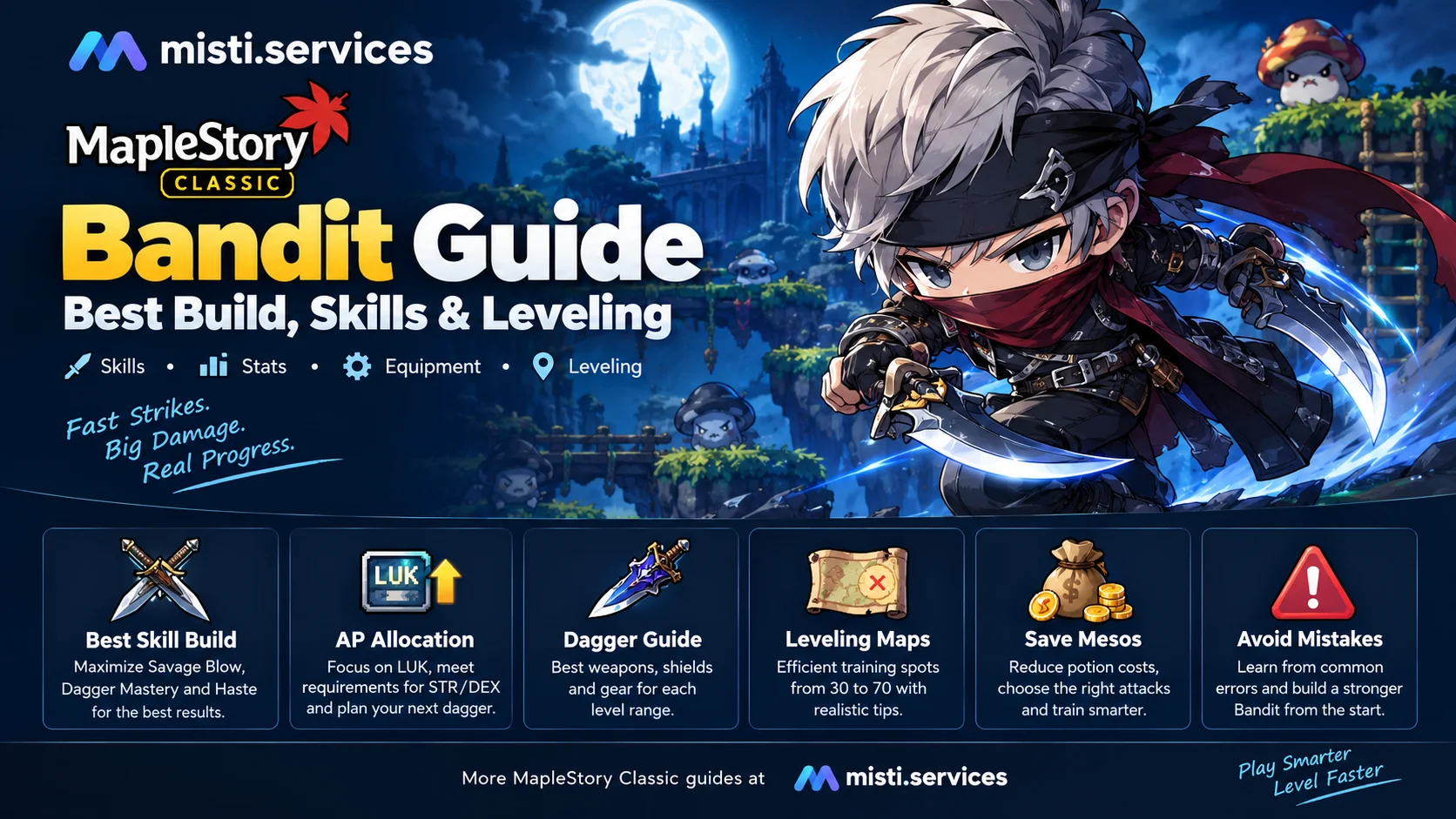
MapleStory Classic Bandit Guide: Best Build, Skills & Leveling
MapleStory Classic Bandit Guide: Best Build, Skills and Leveling
The Bandit is the dagger-wielding second job of the Thief class in MapleStory Classic. Unlike Assassins, who specialize in throwing stars and attacking from a distance, Bandits fight at close range and rely on fast dagger attacks, powerful combos, mobility, and precise skill progression to defeat their enemies.
Bandits become particularly interesting as they develop Savage Blow, an attack capable of striking one enemy multiple times in a single animation. Combined with Dagger Mastery, Dagger Booster, Haste, and Steal, the class can deliver excellent single-target damage while maintaining useful party support. The trade-off is limited attack range, significant potion consumption, and the need to plan your weapon requirements carefully.
The biggest mistake new Bandits make is investing skill points without considering their existing Thief build. Your early attack determines whether you should prioritize dagger skills immediately, continue throwing stars temporarily, or consider a skill reset later. Making this decision before spending your points can save both mesos and valuable progression time.
This guide explains how to build a Bandit from level 30 to level 70, allocate AP, choose between DEX and STR dagger paths, prioritize second-job skills, select training locations, and manage your expenses efficiently.
Is Bandit the Right Class for You?
Bandit is an excellent choice for players who enjoy fast melee combat and concentrating damage on individual enemies. Savage Blow eventually reaches six hits per attack, making it the defining offensive skill of the class. Dagger Mastery improves consistency, while Haste increases movement and jump, helping you reach monsters and move between platforms more efficiently.
The class also offers tools beyond direct damage. Steal can attack up to two monsters and, on a successful steal, provide a powerful temporary Attack Power buff. Nimble Recovery can restore HP and MP after an evade, while a dagger-and-shield setup gives you an additional defensive advantage through the shield's Guard mechanic.
The main disadvantage is having to fight close to your targets. Bandits have limited reach, so monsters can hit you frequently while you attack. That creates a constant need to balance damage, movement, positioning, and recovery costs. A map that looks excellent on paper may be inefficient if the monsters deal too much contact damage.
Bandit suits players who want strong single-target damage, active melee gameplay, and a class that rewards careful investment. It is less appealing to anyone who prefers ranged combat, effortless area clearing, or minimal consumable expenses.
Claim your first-visit discount now
Best Bandit Stats: AP Allocation Explained
LUK is the primary damage stat for Bandits. STR and DEX contribute to damage as secondary stats, but their more important role is usually meeting the requirements of your chosen daggers and armor.
This means you should not automatically distribute AP equally between LUK, STR, and DEX. Raising the wrong stat can delay your progression into a more powerful weapon without offering a comparable damage improvement.
Stat | Recommended priority | Explanation |
|---|---|---|
LUK | Highest priority | Provides the greatest contribution to dagger damage |
DEX | Requirement-based | Needed for DEX daggers, armor, and additional Accuracy |
STR | Requirement-based | Needed for certain dagger types and provides some secondary damage |
INT | Avoid unnecessary investment | Does not improve standard dagger damage |
The most reliable approach is to identify the next dagger you intend to equip, calculate the total STR or DEX it requires, and invest only enough AP to meet that threshold. Include bonuses from your other equipment when calculating how much base AP you need.
Once the necessary requirements are covered, invest the remaining AP into LUK. This also makes it easier to compare equipment upgrades because you can determine whether a new item provides a meaningful benefit without forcing you to change your entire stat distribution.
DEX daggers versus STR daggers
Bandits have two main dagger paths. DEX daggers generally offer slightly higher base Weapon Attack, while STR daggers attack one speed stage faster. Both paths still benefit primarily from LUK, so choosing a STR dagger does not mean you should start investing everything into STR.
Level | DEX dagger | STR or fast alternative |
|---|---|---|
30 | Reef Claw | Cass |
40 | Gephart | Korean Fan |
50 | Shinkita | Sai |
60 | Deadly Fin | Serpent's Coil |
70 | Kandine | Golden River |
The precise requirements vary between weapons. Korean Fan is a notable exception to the ordinary STR progression because it requires LUK rather than STR or DEX. Weapon availability also matters, so research where the next dagger comes from before committing to its requirements.
DEX daggers are a straightforward option if you want to follow a conventional Thief equipment progression. Faster STR daggers are worth considering when their attack speed and available weapon options justify the additional AP commitment.
Do not invest in both STR and DEX simply because you want access to every dagger. Choose a weapon path, calculate its requirements, and keep most of your AP in LUK.
Bandit Skills Explained
The second-job skill set contains six skills, each serving a different purpose. Some increase damage directly, others provide buffs or resource recovery, and the strongest build develops them in an order that matches the character's current attack.
Savage Blow
Savage Blow is the signature Bandit attack. It strikes a single enemy multiple times, and its damage improves through important hit breakpoints as you invest more skill points.
At skill level 21, Savage Blow reaches six hits. At level 30, each hit deals 75% skill damage, producing 450% combined skill damage across the six hits. This makes Savage Blow the central long-term offensive skill for a dagger-focused Bandit.
However, reaching the maximum rank is not always the first priority. Dagger Mastery improves minimum damage and makes your attacks more consistent, which can be especially important when trying to defeat a monster in a predictable number of hits.
Your existing first-job skills also matter. A Bandit who already has a strong Double Stab build may benefit from developing Dagger Mastery before completing Savage Blow, while a character who leveled with Lucky Seven may prefer to keep using throwing stars temporarily.
Dagger Mastery
Dagger Mastery is one of the most important investments in the entire class. It improves dagger damage consistency, increases Critical Rate, and provides a chance to resist knockback effects.
The improvement to minimum damage is especially valuable when planning efficient training routes. A monster that occasionally survives your attack can cost considerably more time and MP than one you can defeat consistently.
For this reason, a strong dagger build should not simply maximize Savage Blow as quickly as possible without considering Mastery. Improving the reliability of each attack can deliver better real-world experience gains than adding more damage to an otherwise inconsistent setup.
Dagger Booster
Dagger Booster increases the attack speed of your equipped dagger for a limited duration. Even its first rank grants the full two-stage speed increase, while additional points extend the duration and reduce the HP and MP cost.
The initial skill point is therefore a useful investment once you meet the prerequisites. Further points can be added later when the benefits of longer uptime justify delaying another skill.
Remember that Booster only applies while you have a dagger equipped. It is not a permanent passive increase, so maintaining the buff becomes part of your normal training routine.
Haste
Haste increases movement speed and jump for you and nearby party members. It is useful for practically every Bandit build because melee characters must move between enemies before they can deal damage.
Its value is not limited to party play. Faster movement helps you navigate platforms, avoid unnecessary walking, reach respawned monsters, and improve your overall training rhythm.
If you continue using Lucky Seven after becoming a Bandit, Haste can be an effective early investment because your ranged attack remains available while your second-job skills develop. Dagger-focused builds can also benefit from an early point before prioritizing their core damage skills.
Steal
Steal attacks up to two enemies and attempts to steal an item from them. A successful steal can stun the target and grants a temporary Attack Power bonus. At maximum rank, that buff can provide a substantial improvement to your subsequent dagger attacks.
The skill becomes particularly useful once you incorporate it into a consistent combat rotation. Apply Steal when its buff is missing, then follow up with Savage Blow or Double Stab.
Steal should not be treated as a replacement for Savage Blow. It has a different role, and its attack is generally not your primary tool for eliminating a single durable enemy. Its value comes from the combined utility of attacking multiple targets, stunning enemies, attempting a steal, and increasing your following damage.
Nimble Recovery
Nimble Recovery can restore HP and MP when you evade an attack, subject to its activation conditions and cooldown. It provides passive resource savings and can help reduce consumable requirements during longer sessions.
The main limitation is that you cannot control exactly when an evade occurs. Do not deliberately take unnecessary risks in an attempt to trigger recovery, and do not assume the skill will replace regular potions.
Its priority depends on your build. Some players prefer investing more points into Nimble Recovery for additional sustain, while others put more into Dagger Booster or Steal. The right balance depends on how long you train between restocking and how often you benefit from the passive effect.
Best Bandit Skill Build for Levels 30-70
There is no single skill order that suits every Bandit because the class can enter second job with different first-job builds. Before spending your first Bandit SP, determine whether your main attack is Double Stab or Lucky Seven and whether you are willing to use an SP Reset Scroll.
The following progression is a practical starting point for a dagger-oriented character that already has Double Stab developed from first job and wants to avoid resetting its earlier skills.
Recommended no-reset dagger build
Level | Skill investment | Objective |
|---|---|---|
30 | Haste +1 | Obtain an early mobility buff |
31-37 | Dagger Mastery to 20, with Dagger Booster +1 after the prerequisite | Improve damage consistency and unlock attack-speed support |
38-44 | Savage Blow to 21 | Reach the six-hit breakpoint |
45-47 | Savage Blow to 30 | Maximize your primary attack |
48-54 | Haste to 20 | Maximize movement and jump support |
54-58 | Nimble Recovery investment | Add passive HP and MP recovery |
58-68 | Steal to 30 | Develop the secondary attack and its buff utility |
68-70 | Additional Dagger Booster points | Extend attack-speed buff duration and reduce upkeep |
This is a progression framework rather than an instruction to ignore every intermediate point. The exact placement of a few remaining skill points depends on your current ranks and whether you prefer longer Booster uptime or stronger passive recovery.
Dagger Mastery deserves special attention. It improves your minimum damage and helps make kills more predictable, which is one of the main reasons a Mastery-first route can outperform rushing Savage Blow in the early levels.
Bandits who leveled with Lucky Seven
If you followed a throwing-star build during your first job, switching to daggers immediately at level 30 is not necessarily optimal. Lucky Seven can remain competitive while your second-job dagger skills develop.
One option is to continue using Lucky Seven while investing in Savage Blow, Dagger Mastery, and an early Dagger Booster point. A practical transition point is around level 36, when Savage Blow 12, Dagger Mastery 6, and Dagger Booster 1 can make dagger combat competitive with the existing throwing-star setup, depending on your equipment.
Another option is to use an SP Reset Scroll later, commonly planned around level 40. This allows you to reorganize first-job SP into a stronger dagger-focused configuration while restructuring your second-job skills.
A reset can make sense if you have calculated the expected benefit and can afford the cost. It is not mandatory for a successful Bandit, however, and players who want to minimize spending should plan their original Thief build carefully enough to avoid depending on resets.
What should you prioritize by level 70?
Your core targets should be maximum Dagger Mastery, maximum Savage Blow, and maximum Haste. These form the foundation of a conventional second-job Bandit.
Your remaining points can be allocated between Steal, Nimble Recovery, and Dagger Booster. A build emphasizing Steal gets the maximum available value from its temporary Attack Power buff. A build that invests more in Nimble Recovery emphasizes resource sustainability, while additional Booster points reduce how often you need to refresh your attack-speed buff.
You cannot maximize all six second-job skills using only the SP gained between levels 30 and 70. Choose the remaining skill ranks based on the problems you are trying to solve rather than spreading points randomly.
Best Bandit Training Locations
Bandits need to consider more than monster level when selecting a training map. Since most of their damage comes from melee attacks, high contact damage can lower your effective experience rate and increase potion expenses.
A strong training area should offer a reliable hit rate, monsters that can be defeated in a predictable number of attacks, manageable incoming damage, and a map layout that does not force you to spend too much time traveling between targets.
Levels 30-39: Transition into dagger combat
The first part of second job is about improving your attack while keeping your existing Thief build useful. Players who still rely on Lucky Seven can compare areas such as Transfer Area and Dangerous Steam, while Ant Tunnel II is another practical option as damage improves.
Zombie Mushrooms and Horny Mushrooms can provide consistent experience during the early progression. Check how many attacks you need to defeat them before moving into stronger monsters.
Do not equip a dagger and immediately assume that Savage Blow will be your fastest attack. Your current skill rank, attack speed, weapon, and first-job allocation all influence the result. Continue using your stronger attack until the dagger setup becomes more efficient.
Levels 40-49: Improve consistency and attack speed
This is where your build begins to show its strengths. Dagger Mastery improves minimum damage, Savage Blow approaches its more important hit breakpoints, and suitable equipment upgrades can make a substantial difference.
Ant Tunnel II, Ant Tunnel III, and Excavation Site III are useful areas to compare. The Burnt Land I and The Burnt Land III can also be worthwhile as Savage Blow improves and your equipment allows you to defeat targets more consistently.
Prioritize the monsters that you can defeat reliably instead of selecting a map solely because its enemies provide more experience per kill. A faster one-hit or two-hit route can outperform a harder area that forces you to spend additional time on every enemy.
Levels 50-59: Take advantage of improved damage
During the 50s, aim to use your developing Savage Blow and improved dagger equipment to move into maps with better experience potential. Tree Dungeon, Monkey Forest II is one option worth testing at this stage.
Your priorities should be consistent damage, safe positioning, and limited travel time. Even a small improvement in the number of attacks required for each monster can create a substantial difference over a long training session.
This is also a good time to evaluate your equipment budget. A dagger that significantly improves your kill speed may be worth purchasing, while an expensive upgrade that barely changes the result can be postponed.
Levels 60-70: Refine your route for the final stretch
At higher levels, consider areas such as The Forest of Evil II and suitable Remains Tomb maps. Wraiths in the subway can also be worth testing as you approach level 70.
Your actual results depend on your weapon, buffs, Accuracy, and skill levels. Keep comparing maps instead of assuming that the same location will remain optimal throughout the entire level range.
Because Bandits operate in melee range, dangerous maps deserve extra scrutiny. If enemies take a large percentage of your HP on contact, a theoretically higher experience rate can disappear once potion costs and repeated recovery trips are included.
Dagger and Equipment Guide
Your weapon is one of the most important sources of improvement for a Bandit. Dagger builds scale with Weapon Attack, making the weapon's base stats and available upgrades particularly valuable.
Level | DEX dagger option | Base Weapon Attack |
|---|---|---|
30 | Reef Claw | 48 |
40 | Gephart | 58 |
50 | Shinkita | 68 |
60 | Deadly Fin | 78 |
70 | Kandine | 88 |
These are reference values for the listed weapons before scrolling or equipment bonuses. STR-oriented alternatives can offer a different attack-speed profile, so compare the full weapon setup rather than treating the DEX progression as the only possible route.
Why shields matter
Bandits can equip daggers and shields together. A shield is not merely an additional source of Weapon Defense, because its Guard mechanic can completely block eligible physical hits.
Shield Defense upgrades can improve both defense and the probability of triggering Guard. This creates an additional defensive benefit for a class that spends much of its time within contact range of enemies.
Choose a shield that supports your equipment plan without forcing you into unnecessary stat investment. A small stat bonus can be useful when it meets a dagger requirement, but there is little reason to spend valuable AP on a requirement that could be covered more efficiently by equipment.
Weapon Attack versus Critical Rate on gloves
For a conventional Bandit, Weapon Attack is a particularly important offensive stat because it improves every dagger hit, including the weakest damage rolls. Critical Rate increases how frequently critical damage occurs, but does not directly improve every attack.
When comparing glove scrolls or other upgrades, check the actual stats of each option and your current build. In many standard damage setups, Weapon Attack provides a more reliable improvement than an equivalent investment in Critical Rate.
You should also evaluate the cost of successfully scrolling an item. A theoretically superior glove is not automatically a good purchase if acquiring it consumes the money you need for weapons, potions, and future upgrades.
How to Save Mesos While Leveling
Bandits have two recurring expenses: HP recovery from close-range combat and MP recovery for their offensive skills. Savage Blow becomes more expensive as you develop it, so using the strongest attack against every monster can quickly drain your budget.
First, keep your kill speed in mind. Double Stab can remain useful when it defeats a monster in the same number of attacks as Savage Blow but consumes less MP. The correct choice is the attack that offers the best combination of reliable kills and overall resource efficiency, not necessarily the one with the largest damage number.
Second, choose HP and MP potions according to recovery per meso. A potion that restores more health is not automatically more economical if it costs disproportionately more. Compare the recovery values of the items available to you and purchase according to your character's actual needs.
Third, use your buffs efficiently. Dagger Booster has an ongoing cost, but maintaining the appropriate attack speed can improve your damage output. Haste also reduces unnecessary movement, helping you spend more time attacking and less time navigating the map.
Finally, consider the distance between your training area and your refill location. A map with marginally better experience can become less attractive when you repeatedly need to travel back to town. Your real progression rate is determined by the entire training loop, not just the time spent attacking monsters.
For a broader explanation of budgeting and equipment decisions, read the MapleStory Classic Meso Saving Guide.
Common Bandit Mistakes to Avoid
The first mistake is switching to daggers too early. If Lucky Seven is still your most effective attack, continue using it while you improve your second-job skills. Your job advancement does not require you to abandon a working setup immediately.
Another mistake is treating Savage Blow as the only skill that matters. Dagger Mastery can improve damage consistency, while Haste supports movement and Booster improves attack speed. A balanced build often performs better than an attack skill that has been maximized without considering its prerequisites or supporting abilities.
A third mistake is putting too much AP into STR or DEX. Requirements matter, but unnecessary investment in secondary stats can reduce the amount of LUK you have available. Plan your weapons and armor before spending points.
You should also avoid ignoring Double Stab once Savage Blow becomes available. If both attacks provide the same reliable kill and Double Stab costs less MP, it can remain the more economical choice in that situation.
Lastly, do not ignore shields or choose a training map solely because of its monster level. Defense, Guard, Accuracy, damage per attack, and the number of casts needed all influence the quality of your progression.
Frequently Asked Questions
What is the best Bandit build in MapleStory Classic?
A strong conventional build prioritizes Dagger Mastery, Savage Blow, and Haste, then distributes the remaining SP between Steal, Nimble Recovery, and Dagger Booster. The exact skill order should reflect your first-job build and whether you intend to use a skill reset.
Should Bandits use STR or DEX daggers?
Both options are viable. DEX daggers generally offer slightly higher base Weapon Attack, while STR daggers attack one speed stage faster. Choose based on weapon availability, stat requirements, equipment, and your preferred progression instead of splitting AP between both weapon paths without a plan.
Is Savage Blow better than Double Stab?
Savage Blow becomes the defining second-job attack, especially after reaching its six-hit breakpoint at skill level 21. However, Double Stab can still be useful when it guarantees the same kill for less MP. Compare the result against your current target rather than assuming one skill must always replace the other.
When should a Bandit use an SP Reset Scroll?
A reset can be worthwhile if you leveled with Lucky Seven and want to reorganize your first-job skills around a dagger build. Around level 40 is a possible planning point, but you should compare the expected improvement against the scroll's cost. A well-planned no-reset build is a valid alternative.
How can Bandits reduce potion costs?
Choose efficient training areas, use Double Stab when it provides the same reliable kill at a lower MP cost, and compare potion recovery per meso. Improving the number of attacks needed to defeat each monster can also lower the overall cost of a training session.
What happens after level 70?
Level 70 marks the end of the second-job progression covered here. Keep your final skill allocation and equipment goals organized so that you can adjust your build when the next job advancement becomes available in your version of MapleStory Classic.
Continue Your MapleStory Classic Progression
Bandit rewards players who approach progression with a plan. Prioritize LUK while meeting weapon requirements, develop Dagger Mastery and Savage Blow in the right order, and make Haste and your remaining utility skills work together with your preferred training style.
Most importantly, measure success by consistent kills and sustainable experience gains rather than by character level alone. The right weapon, skill order, and training map can make a much bigger difference than spending mesos on upgrades that do not address your current weaknesses.
Start with the MapleStory Classic Thief Guide if you are preparing for second job, or visit the MapleStory Classic Beginner's Guide for broader progression advice.
When you want to spend less time repeating the leveling process, explore the available MapleStory Classic leveling services at misti.services and choose an option that fits your goals and budget.