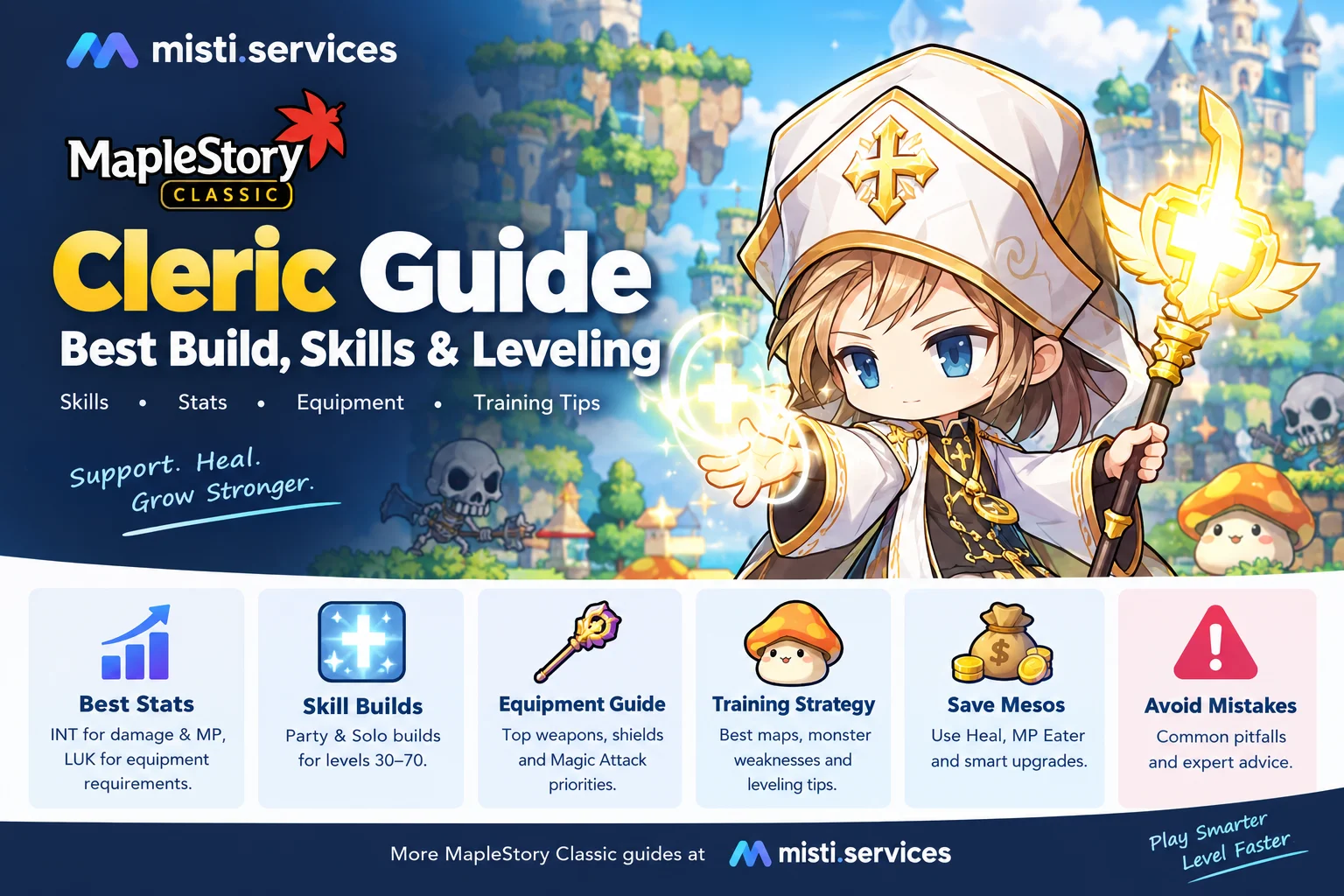
MapleStory Classic Cleric Guide: Best Build, Skills & Leveling
MapleStory Classic Cleric Guide: Best Build, Skills and Leveling
The Cleric is the support-focused second job of the Magician class in MapleStory Classic. Instead of relying entirely on raw spell damage, Clerics combine healing, defensive buffs, efficient resource management, and specialized attacks against undead monsters. This gives the class a distinct role in party play while also creating some useful opportunities for players who prefer to level alone.
However, choosing Cleric does not automatically make leveling easy. Your damage against ordinary monsters can feel underwhelming compared with other second-job classes, and your results depend heavily on skill allocation, monster selection, Magic Attack, and how efficiently you manage MP. The advantage comes from understanding where the class performs best rather than trying to play it like a conventional damage-focused Magician.
This MapleStory Classic Cleric guide covers the progression from level 30 to level 70, including the recommended ability point distribution, the most important skills, separate builds for solo and party players, equipment priorities, and practical training strategies. The goal is to help you gain experience consistently without wasting skill points or spending your entire meso supply on potions.
Is Cleric the Right Class for You?
Cleric is a strong choice for players who enjoy supporting groups, keeping their characters alive, and taking advantage of monster weaknesses. Heal provides recovery while also damaging undead enemies, Bless improves party survivability, and Invincible reduces the physical damage you receive from monster contact. Teleport also makes moving around training maps considerably more convenient as you invest more points into it.
The class is particularly comfortable when fighting suitable undead monsters. Instead of relying exclusively on ordinary offensive spells, you can use the interaction between Heal, Holy Arrow, and monster weaknesses to make better use of your available skills. This gives Clerics an efficient niche that becomes more valuable when you choose your training targets carefully.
The trade-off is single-target damage against monsters without a relevant weakness. Clerics are not designed to compete with every other class in straightforward damage races, and Holy Arrow does not provide the large-scale mob clearing associated with multi-target attacks. Your early skill investments and training locations therefore matter more than simply choosing the highest-level monster available.
Choose Cleric if you value survivability, party utility, and a more economical approach to progression. Players who prioritize fast damage against ordinary monsters may prefer a different class, but Cleric can reward a patient player who understands its strengths.
Claim your first-visit discount now
Best Cleric Stats: How to Allocate AP
Intelligence (INT) is your primary stat as a Cleric. It supports your magic damage, increases your MP pool, and contributes to the accuracy used by Magicians. Luck (LUK) has a secondary role because your equipment requires certain stat thresholds, and it also contributes to the Cleric's Heal calculations.
For most conventional builds, the best approach is to invest in INT whenever your character has enough LUK to equip the next planned weapon and other important items. Putting unnecessary points into LUK can delay your damage progression, while ignoring equipment requirements can leave you unable to use an upgrade when it becomes available.
A common starting guideline is to keep base LUK around your character level minus 10, then put the remaining AP into INT. Treat this as a planning reference rather than an inflexible rule. Check the requirements of the next weapon you intend to use and account for any LUK provided by your equipment before assigning your points.
Stat | Recommended approach | Why it matters |
|---|---|---|
INT | Main AP investment | Improves magical damage and supports MP and Accuracy |
LUK | Meet equipment requirements | Allows access to the planned weapon and gear progression |
STR | Avoid unnecessary investment | Does not improve your normal magic damage |
DEX | Avoid unnecessary investment | Not a priority for the standard Cleric build |
Before spending a level's AP, check the requirements of the next available wand or staff. You do not need to invest in extra LUK simply because a higher-level item exists. Invest only when it helps you reach a useful equipment milestone, then return to INT.
Players who have not yet completed their first-job Magician progression should review the MapleStory Classic Magician Guide before committing to a second-job build. The early stat and skill decisions carry forward, so preparing before level 30 can prevent unnecessary corrections later.
Cleric Skills Explained
A good Cleric build balances offensive progression with the abilities that make the class valuable. Every skill has a purpose, but their priority depends on whether you spend most of your time grinding alone or supporting a group.
Holy Arrow
Holy Arrow is your principal offensive skill for the recommended second-job builds. It attacks one target with holy damage and is particularly effective against enemies that are weak to the element. This makes it useful for specialized training routes, but it does not solve every damage problem.
Do not assume that Holy Arrow should replace your first-job attack immediately against every monster. Its performance depends on the skill's current level and the target's elemental properties. Against holy-weak enemies, Holy Arrow can become worthwhile earlier than it does against elemental-neutral targets. During the transition, compare how many casts each attack needs and how much MP it consumes.
The practical goal is to establish a reliable offensive skill without sacrificing too many levels to expensive or inefficient attacks.
Heal
Heal is one of the defining abilities of the Cleric. It restores HP to nearby party members and can damage undead monsters in range. This dual purpose gives the skill value in both group encounters and specialized solo training.
Heal is also important for keeping potion costs under control. Once you have invested enough points in it, your recovery skill can replace many routine HP potion purchases, allowing you to remain in a training area longer.
There is an important mechanic to understand when fighting undead enemies. Heal's targeting and shared recovery behavior mean that nearby party members and undead targets can influence the result of a cast. When your own HP is dangerously low, stepping away from nearby undead before healing can help you avoid turning a recovery cast into an inefficient combat action.
Heal is a valuable skill, but it is not a universal area attack. Use it according to the enemies you are fighting and the number of nearby targets.
Bless
Bless is the party-oriented defensive skill. It reduces damage taken by nearby party members and improves the recovery provided by Heal. Its value is most apparent when playing with a group that can benefit consistently from the buff.
The main consideration is timing. Bless requires five points in Invincible, which means you must invest in Heal first and build toward the required defensive skill before accessing it. This creates a natural decision point for Clerics who want to prioritize party support rather than personal protection.
If you play with friends or regularly join parties, Bless deserves a substantial part of your second-job skill budget. Its contribution is less immediate when you spend most of your time alone.
Invincible
Invincible reduces physical damage taken from monster contact and provides a small contact-damage effect. It is a practical survival skill that helps make solo grinding more manageable, particularly when enemies frequently reach your character.
Its importance changes with your playstyle. A solo Cleric benefits from investing in more ranks because the reduced contact damage can lower the number of emergency potion uses during a long session. A party Cleric can keep Invincible at the prerequisite level and allocate more points to Bless instead.
This is one of the most important decisions in the Cleric skill build. Neither approach is universally correct, so choose according to how you actually play.
MP Eater
MP Eater provides a chance to absorb MP from enemies when attacking with magic skills. It can reduce the amount of money you spend on MP recovery, but its usefulness depends on the monsters you fight and how much MP they have available.
The skill is not equally effective against every target. Some monsters have no MP to absorb, and the effect cannot trigger continuously without restriction. Treat it as a long-term resource-saving investment rather than a replacement for choosing an efficient training location.
Teleport
Teleport allows your character to move quickly across a map without walking through every platform or enemy. Its higher ranks improve the distance and efficiency of the movement skill, making it increasingly useful as your training routes become more demanding.
Early access to Teleport can make movement more comfortable, but maxing it immediately is not always the fastest route to better experience. Your first priority is building an effective attack and securing the skills that match your chosen playstyle. You can complete Teleport later without compromising the main direction of the build.
Best Cleric Skill Build for Levels 30-70
There are two practical ways to develop your Cleric. The party build prioritizes Bless and healing support, while the solo build invests more heavily in Invincible to make independent training safer.
Both approaches eventually develop Holy Arrow, Heal, MP Eater, and Teleport. The primary difference is how you distribute your defensive skill points and when you invest in them.
Party Cleric build
The party build is recommended if you regularly group with other players, provide support during shared training, or want your defensive buffs to benefit the entire party.
Level | Skill allocation | Purpose |
|---|---|---|
30 | Heal +1 | Unlock basic recovery |
31 | Teleport +1, MP Eater +1, Holy Arrow +1 | Obtain movement, resource recovery, and an offensive option |
32-40 | Holy Arrow +27 | Develop your primary second-job attack |
41 | Holy Arrow +2, Heal +1 | Max Holy Arrow and continue healing progression |
42 | Heal +3 | Reach Heal level 5 |
43-44 | Invincible +5, Bless +1 | Unlock Bless |
45-49 | Bless +15 | Build the party defensive buff |
50-58 | Heal to 30, then MP Eater +2 | Max recovery and continue resource investment |
59-64 | MP Eater to 20, Teleport +1 | Complete MP Eater and begin improving Teleport |
65-70 | Teleport to 20 | Maximize movement distance |
This build prioritizes Holy Arrow during the main offensive development phase, then unlocks Bless as soon as the necessary prerequisites are met. Healing receives a substantial investment afterward, while MP Eater and Teleport finish the progression.
Solo Cleric build
The solo build suits players who prefer independent grinding and want to reduce damage from monster contact. It keeps Bless at a minimal level and invests more heavily in Invincible.
Level | Skill allocation | Purpose |
|---|---|---|
30 | Heal +1 | Obtain basic self-healing |
31 | Teleport +1, MP Eater +1, Heal +1 | Improve movement, recovery, and resource efficiency |
32-41 | Holy Arrow +30 | Max the main second-job attack |
42 | Heal +3 | Reach Heal level 5 |
43-49 | Invincible to 20, with MP Eater +1 at level 49 | Improve personal protection and begin MP recovery investment |
50-55 | MP Eater to 20 | Improve resource efficiency |
56-62 | Teleport to 20, with Heal +2 at level 62 | Complete Teleport and continue recovery progression |
63-70 | Heal to 30, Bless +1 | Finish the healing skill and unlock a basic party buff |
The progression above describes the core priorities rather than a reason to ignore every situational adjustment. If you prefer more mobility earlier, or already have equipment and consumables that make survival comfortable, your own allocation may need a small adjustment. The important part is to avoid spreading points across both defensive paths without a clear reason.
Which build should you choose?
The party build is the natural choice if you frequently play alongside other characters and want Bless to contribute throughout group training. The solo build is more appropriate when you spend long periods fighting independently and find that incoming contact damage is a significant expense.
You do not need to choose according to what other Clerics are playing. Consider the way you spend most of your time in the game, then build toward that objective. A support-focused character that rarely joins parties may benefit more from solo survivability, while a Cleric that regularly plays with friends can gain more from group buffs.
Best Training Strategy for Cleric
Your training location should be selected according to actual damage, Accuracy, monster weaknesses, recovery costs, and travel time. Higher monster levels do not automatically translate into better progression. If your character misses regularly or needs several attacks to defeat every enemy, a lower-level map may provide more consistent experience.
Cleric has a particularly useful advantage when a map contains monsters that are weak to holy damage or are susceptible to Heal. Use that advantage to compensate for the class's limitations against ordinary targets.
Levels 30-40: Build toward Holy Arrow
During the early second-job levels, your main objective is to establish Holy Arrow while keeping your training costs under control. Do not force the skill against every enemy before it becomes efficient.
Against elemental-neutral monsters, your first-job Magic Claw or Energy Bolt may remain useful while Holy Arrow is still developing. When fighting suitable holy-weak enemies, Holy Arrow can become competitive earlier. Zombie Mushrooms and Jr. Wraiths are examples worth considering as you progress.
At this stage, focus on reliable kills, manageable potion consumption, and accurate attacks. If a training location causes frequent misses, compare your Accuracy and equipment before committing to a long session.
Levels 40-49: Take advantage of monster weaknesses
Once Holy Arrow is developed, look for training areas where you can use it consistently against suitable enemies. Zombie Lupins, Jr. Wraiths, and other appropriate undead or holy-weak targets can be useful depending on your current level and damage.
Ant Tunnel II and Excavation Site III are options to compare around level 41. Their relative value depends on your equipment, kill speed, and how often you need to return to town. A map that provides slightly less experience can still be worthwhile if the route is safer or allows faster potion refills.
Do not change maps solely because you have reached a particular level. Move when your current character can defeat the next targets efficiently.
Levels 50-59: Balance damage and defensive progress
During the 50s, your build should increasingly reflect your chosen playstyle. Party Clerics gain more value from Bless and Heal, while solo players benefit from the stronger personal protection provided by Invincible.
Line 1, Area 2 and The Burnt Land I are examples of locations to evaluate around this stage. Compare the enemies available in your version of the map and whether Holy Arrow gives you a meaningful advantage.
Pay attention to the total cost of a training session. An upgrade that saves one cast on many monsters can be more valuable than spending the same mesos on a small stat increase that does not change your practical kill speed.
Levels 60-70: Refine your route instead of chasing monster levels
At higher levels, use your developed skill set to look for monsters that can be defeated in one or two casts with reliable Accuracy. Tree Dungeon areas such as Forest Up North VIII and IX are locations worth testing around level 60, while suitable Wraith areas can provide additional options later in the progression.
These are starting points rather than universal recommendations. Your available gear, spell damage, monster density, and time spent walking between targets can change which map performs best.
Evaluate an alternative training area by comparing experience gained over a consistent period, potions consumed, the frequency of misses, and the time required to replenish supplies. Repeat the comparison whenever your weapon or skill progression produces a significant improvement.
Cleric Equipment Guide: Weapons, Shields and Magic Attack
Equipment should support your actual build rather than simply fill every slot with the highest-level item you can find. For Clerics, Magic Attack is an especially important weapon consideration because your standard offensive spells scale with magical stats rather than ordinary Weapon Attack.
Wands and staves can both be viable, and either can be paired with a shield when the weapon and equipment rules allow it. Compare their Magic Attack, stat requirements, available upgrades, and total cost before making a purchase. Weapon speed is not the deciding factor for spellcasting in the same way it is for physical attacks.
The following weapons provide useful progression checkpoints for a conventional Cleric build.
Character level | Weapon to consider | Base Magic Attack |
|---|---|---|
30 | Mithril Wand | 55 |
40 | Fairy Wand | 69 |
50 | Cromi | 83 |
55 | Thorns | 87 |
60 | Evil Tale | 97 |
65 | Evil Wings | 101 |
70 | Angel Wings | 111 |
These figures are reference values before scrolling or other stat modifications. Availability and affordability can vary, so check current item sources and market prices before building your AP allocation around a planned purchase.
Shields are also worth considering because they can improve your defensive setup. Some options emphasize physical defense and blocking, while mage-oriented alternatives can offer additional Magic Defense. Choose according to the threats you encounter and the actual attributes of the item available to you.
When evaluating upgrades, prioritize Magic Attack on your weapon and relevant equipment stats, then check INT, LUK requirements, defensive bonuses, and scrolling costs. Magic Attack scrolls on gloves are generally a more relevant damage investment for a conventional spell-focused Cleric than Weapon Attack upgrades.
You can also consult the MapleStory Classic Meso Saving Guide before spending heavily on equipment. Your next purchase should solve an actual problem, such as improving damage, meeting a weapon requirement, or making a difficult training route more sustainable.
How to Save Mesos While Leveling a Cleric
Clerics can be relatively economical when their healing and MP recovery skills are used efficiently, but poor training choices can still consume a large portion of their income.
First, use Heal to handle routine HP recovery whenever it is appropriate and safe. This can reduce your dependence on HP potions and allow you to stay in a training area longer. Keep consumables for emergencies, unexpected damage, and situations where casting Heal would leave you vulnerable.
Second, pay attention to MP Eater's limitations. It is more useful when your target has MP available, so an expensive offensive spell against a monster that provides little practical resource recovery can be less economical than expected. Choose targets according to the combined value of their experience, damage taken, and consumable costs.
Third, stop treating every equipment upgrade as mandatory. A new wand that materially reduces the number of casts needed to kill a monster may justify its price. A small upgrade that leaves your kill speed unchanged may be better postponed until you have secured your regular training budget.
Finally, compare your actual results rather than relying on theoretical experience per kill. A suitable map should offer a repeatable routine that includes combat, recovery, loot collection, and travel to town. If a route constantly drains your mesos, reconsider the targets or adjust your build before spending more money on consumables.
Common Cleric Mistakes to Avoid
One common mistake is choosing Cleric with the expectation of having the highest single-target damage among second-job classes. The class offers support, durability, and specialized offensive opportunities, not exceptional damage against every enemy. Learning which targets suit your skills is a more productive approach than trying to force a weak matchup.
Another mistake is ignoring equipment requirements while allocating AP. Excess LUK can delay Intelligence investment, but insufficient LUK can prevent you from equipping your next weapon. Check each planned milestone before assigning points.
Players also frequently overlook the distinction between Holy Arrow's elemental weakness bonus and Heal's ability to damage undead monsters. The two mechanics overlap but are not identical. Before committing to a training location, confirm that your selected attack actually benefits from the target's properties.
Finally, avoid spending all available skill points on defensive abilities without first building an effective offensive option. Survivability helps you remain in combat, but you still need to defeat monsters at a reasonable pace. A balanced progression that reflects your solo or party preference will generally provide a more comfortable leveling experience.
Frequently Asked Questions
What is the best Cleric build in MapleStory Classic?
The best build depends on your playstyle. A party Cleric prioritizes Holy Arrow, Bless, and Heal while keeping Invincible at the prerequisite level. A solo Cleric invests more heavily in Invincible, then completes MP Eater and Teleport before finishing Heal. Both builds should account for their equipment requirements and training targets.
What stats should a Cleric use?
INT is the primary stat, while LUK should be raised only as needed for your planned equipment. A common guideline is to keep base LUK around your character level minus 10, but verify the requirements of upcoming weapons and account for equipment bonuses before spending AP.
Is Holy Arrow better than Magic Claw?
Holy Arrow is particularly valuable against monsters weak to holy damage. Against neutral enemies, a lower-rank Holy Arrow may not outperform a developed first-job attack. Compare damage, MP consumption, Accuracy, and the number of casts needed to defeat your intended targets.
Is Cleric good for solo leveling?
Yes, especially when you use suitable monsters, maintain a sensible defensive build, and take advantage of Heal and MP Eater where appropriate. However, solo damage against ordinary monsters can be lower than that of more offensive classes, so efficient target selection matters.
Should a Cleric max Bless or Invincible?
Prioritize Bless if you regularly support a party and want to reduce incoming damage for nearby group members. Prioritize Invincible if you usually train alone and want stronger personal protection from monster contact. Your usual playstyle should determine the allocation.
How can Clerics save mesos while leveling?
Use Heal for routine recovery where appropriate, select monsters that your current skills can defeat efficiently, invest in MP Eater when it suits your targets, and purchase gear only when it provides a useful improvement. Account for refill distance and potion consumption when comparing training locations.
Continue Your MapleStory Classic Progression
A well-built Cleric can be a dependable support character with solid survivability and useful opportunities for efficient solo training. The key is to match your AP and SP investments to your equipment, focus on the enemies your skills handle best, and choose training routes according to real performance rather than monster level alone.
For more early-game preparation, read the MapleStory Classic Beginner's Guide and the Magician progression guide. Both can help you prepare your character before committing to the full Cleric build.
When you would rather spend more time playing and less time repeating the same leveling routine, explore the available MapleStory Classic leveling services and meso options at misti.services. Review the current service options and choose an approach that fits your progression goals and budget.