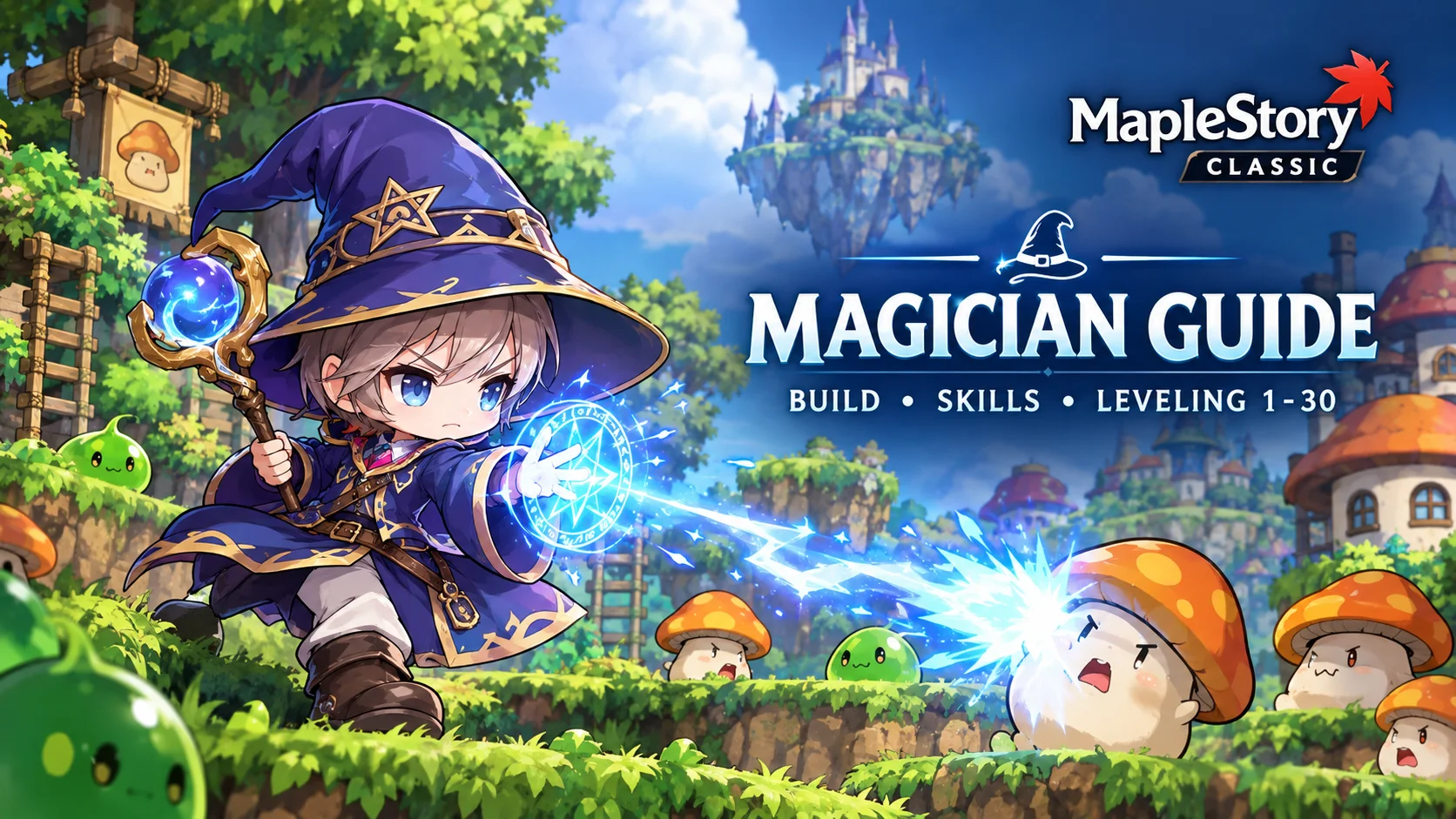
MapleStory Classic Magician Guide: Build & Leveling 1-30
MapleStory Classic Magician Guide: Best Build, Skills and Leveling 1-30
The Magician is one of the most approachable classes in MapleStory Classic World, especially if you prefer ranged combat, powerful spells, and a character that eventually branches into elemental damage or party support. Unlike melee-focused classes, Magicians rely on Intelligence, magic attack, and careful MP management to defeat monsters without getting too close to them.
The early game still requires some planning. You have to distribute your Ability Points correctly, choose an efficient first-job skill build, manage potion expenses, and find monsters you can defeat without wasting MP on missed attacks. Your decisions before level 30 also prepare you for one of three second-job paths: Fire/Poison Wizard, Ice/Lightning Wizard, or Cleric.
This guide covers the complete Magician progression from your first levels on Maple Island to your second job advancement. It explains how to allocate AP and SP, which early spells are worth investing in, what equipment to use, where to train, and how to avoid common mistakes.
Is Magician a Good Class in MapleStory Classic?
Magician is a strong choice for players who enjoy spellcasting and want several different playstyles available later. Its strengths include ranged attacks, useful defensive skills, and a large MP pool that supports frequent spellcasting. The class also offers a natural progression into elemental damage dealers or a more supportive role.
There are some disadvantages to consider. Magicians have comparatively low HP, rely heavily on MP potions, and do not receive a powerful first-job area attack. Early combat is mostly about using single-target spells efficiently rather than clearing entire groups of enemies at once.
Advantages | Disadvantages |
|---|---|
Ranged magic attacks | High MP consumption |
Strong Intelligence scaling | Low HP compared with durable melee classes |
Defensive skills through Magic Guard and Magic Armor | Potion expenses can slow progression |
Access to three different second-job paths | Limited first-job mobbing |
Healing and party support through the Cleric path | Requires careful positioning and resource management |
Magician works well for players who enjoy ranged combat and do not mind managing consumables. Your experience also improves considerably once your main attack is developed and you understand how much defensive protection you actually need.
If you are still choosing your first character, read our MapleStory Classic Beginner's Guide before committing your Ability Points.
Claim your first-visit discount now
Levels 1-10: Preparing for Your First Job
Every character begins as a Beginner on Maple Island. Your first goal is to complete the introductory quests, collect useful rewards, and reach the point where you can travel to Victoria Island.
Do not ignore the early quests simply because you want to become a Magician as soon as possible. Several tasks provide useful experience, starter equipment, and consumables that can save you mesos during the opening levels.
At this stage, your damage primarily comes from physical attacks and beginner skills. You will not have access to your regular magical attacks until you complete the first job advancement.
Beginner AP Allocation
Your long-term goal is to maximize Intelligence because INT is the main stat responsible for Magician spell damage. LUK is a secondary requirement for some weapons, while STR and DEX do not contribute meaningfully to the normal Magician damage setup.
For a standard Magician build, aim for the following starting distribution:
Stat | Starting Value |
|---|---|
STR | 4 |
DEX | 4 |
INT | 12 |
LUK | 5 |
Put the Ability Points earned between levels 2 and 10 into INT. This provides a strong foundation for your first job and avoids wasting points on stats your character does not need.
Unlike some other versions of MapleStory, the Classic World rules covered by this guide do not require a specific INT threshold for the first job advancement. Nevertheless, investing in INT early is important because your points remain with your character after advancing.
Beginner Skill Points
Before level 10, focus on the three useful Beginner skills.
Nimble Feet provides a temporary movement speed increase. It helps you travel between monsters and quest objectives more quickly.
Three Snails allows you to deal ranged damage by consuming the required snail shells. It is useful when approaching a monster with a physical attack would be inconvenient.
Recovery restores HP over time. It can help reduce potion usage during the early game, although its limited recovery and cooldown mean you should not depend on it during dangerous encounters.
With the available Beginner skill points, you can bring all three skills to level 3 by level 10.
Early Weapons and Job Advancement
A basic one-handed weapon is enough for the early Beginner levels. Avoid spending heavily on equipment you will replace almost immediately.
Once you are ready to advance, travel to Ellinia and visit Grendel the Really Old in the Magic Library. He handles the Magician first-job advancement in MapleStory Classic World.
After becoming a Magician, you receive a beginner's Wooden Wand, giving you a starting weapon for magical combat. Put your first Magician skill point into Energy Bolt so you can begin training with ranged magic attacks.
Magician AP Build: Levels 10-30
Once you become a Magician, continue investing in INT while raising LUK only when necessary to equip your next weapon.
The main mistake to avoid is adding too much LUK too early. Every unnecessary point reduces your INT compared with a build that keeps LUK close to equipment requirements. Because INT contributes to both magic damage and Accuracy, maximizing it is especially useful during early progression.
A practical allocation plan is to keep enough LUK for the next weapon tier, then invest the remaining AP into INT.
Level | Recommended Base INT | Recommended Base LUK | Weapon Goal |
|---|---|---|---|
10 | 57 | 5 | Wooden Wand |
15 | 82 | 5 | Hardwood Wand |
20 | 102 | 10 | Metal Wand |
25 | 122 | 15 | Ice Wand |
30 | 142 | 20 | Mithril Wand |
These are example targets for the build described in this guide, not mandatory breakpoints for every character. Equipment bonuses can affect your actual requirements, so check the weapon's stat conditions before spending AP.
The general rule is simple: maximize INT whenever you can, and add only enough LUK to unlock the next useful piece of equipment.
Best Magician Skills: Energy Bolt vs Magic Claw
Your first major decision is choosing your primary attack. Magicians can invest in Energy Bolt or Magic Claw, but spending points on both early will delay the defensive and MP skills that make the first job more comfortable.
Both attacks can be effective. The difference comes down to MP efficiency, damage consistency, range, and how they interact with the terrain.
Energy Bolt
Energy Bolt launches one concentrated projectile at an enemy. At maximum level, it has a 350-pixel range and costs 16 MP per cast.
Its biggest advantage is efficiency. It delivers the same expected total basic attack power as Magic Claw while consuming less MP. It also has a stronger individual damage line, which can improve your chance of knocking a monster backward when your damage reaches its knockback threshold.
For a new character, these benefits make Energy Bolt a strong default choice. Lower MP consumption means fewer trips to a potion shop, leaving more of your mesos available for weapons, armor, and progression.
Magic Claw
Magic Claw strikes a single target twice, with each line dealing a smaller amount of damage. At maximum level, it costs 20 MP per cast and has a shorter range of approximately 300 pixels.
Its main advantage is consistency. Dividing damage into two hits can make the total result less variable from cast to cast. It can also hit enemies through certain walls and platforms, which makes it useful on specific maps where Energy Bolt's projectile is less convenient.
Magic Claw is a reasonable alternative if you prefer its targeting behavior or have a training location where its terrain interaction saves time.
Which Skill Should You Choose?
Feature | Energy Bolt | Magic Claw |
|---|---|---|
Maximum damage structure | One larger hit | Two smaller hits |
MP cost at max level | 16 MP | 20 MP |
Approximate range | 350 pixels | 300 pixels |
MP efficiency | Better | More expensive |
Knockback potential | Stronger individual hit | Depends on each smaller hit |
Terrain interaction | Standard projectile behavior | Can hit through some terrain |
Best general use | Efficient early leveling | Situational terrain advantages |
For most first-time Magicians, I recommend Energy Bolt. It is straightforward to use, costs less MP, and leaves one additional skill point available compared with a maxed Magic Claw route.
Recommended Magician SP Build: Levels 10-30
The first-job skill build should balance offensive power, MP capacity, and defense. Maxing your attack immediately is important, but you also need the supporting skills that reduce downtime and improve survivability.
For a budget-oriented setup, use the following target build by level 30.
Skill | Target Level | Purpose |
|---|---|---|
Energy Bolt | 20 | Main single-target attack |
Improved MP Recovery | 3 | Improves MP recovery and the effectiveness of MP recovery items |
Magic Guard | 3 | Unlocks Magic Armor and provides basic protection |
Magic Armor | 20 | Increases physical and magical defense |
Max MP Increase | 15 | Increases maximum MP |
Magic Claw | 0 | Skipped in the Energy Bolt build |
This setup focuses on efficient training while keeping potion expenses under control. It is not the only possible build, but it provides a balanced starting point for a new character.
How to Allocate SP
Start by placing one point into Energy Bolt when you first become a Magician. Continue raising Energy Bolt as your primary attack, while taking an early point in Improved MP Recovery to improve potion efficiency.
Once Energy Bolt is maxed, put the required points into Magic Guard to unlock Magic Armor. After meeting that requirement, prioritize Magic Armor before finishing Max MP Increase.
A simplified progression looks like this:
Level Range | Main Priority |
|---|---|
10-17 | Develop and max Energy Bolt |
17-19 | Reach Magic Guard 3 and unlock supporting skills |
20-26 | Invest heavily in Magic Armor |
26-30 | Finish Max MP Increase |
This is a planning outline rather than an exact point-by-point spending schedule. Follow the skill prerequisites and confirm the points available at each level so you do not accidentally leave a required skill unfinished.
Remember that second-job skill points cannot be used to repair your first-job build. Finish the necessary first-job skills before advancing at level 30.
Magic Guard or Magic Armor?
These two skills serve different purposes.
Magic Guard redirects a portion of incoming HP damage to MP. It is useful when you need extra protection against monsters that can quickly reduce your health, but the transferred damage consumes the resource you also need to cast spells.
Magic Armor increases your defenses, reducing the physical damage you take before it becomes necessary to consume HP or MP through Magic Guard.
If your main concern is keeping training costs down, prioritizing Magic Armor can be more economical. If you are facing enemies that hit hard enough to threaten your survival, raising Magic Guard becomes more attractive.
The correct balance depends on how frequently you get hit, your equipment, and the cost of your available potions. You do not necessarily need to keep Magic Guard active at its maximum level while fighting weak monsters that rarely touch you.
Why Max MP Increase Matters
Max MP Increase improves your maximum MP pool, allowing you to cast more spells before needing to refill. It is an important long-term skill because Magicians spend MP on almost every meaningful combat action.
However, delaying it temporarily to unlock Magic Armor does not automatically mean you have lost your long-term MP progression. The recommended build catches up on Max MP Increase before level 30.
Best Equipment for Magician Levels 10-30
Your most important equipment upgrade is your wand or staff. Magic Attack directly improves spell damage, while ordinary Weapon Attack affects physical attacks rather than your spell damage.
During levels 10-30, wands are generally the practical choice. Comparable early wands offer more Magic Attack than their staff alternatives and often require less LUK. The weapon's physical attack speed does not make Energy Bolt or Magic Claw cast faster.
Recommended Weapon Progression
Level | Recommended Weapon | Approximate Magic Attack |
|---|---|---|
10 | Wooden Wand | 27 |
15 | Hardwood Wand | 34 |
20 | Metal Wand | 41 |
25 | Ice Wand | 48 |
30 | Mithril Wand | 55 |
Use these values as a guide for the equipment progression covered here. Check the item requirements and available alternatives in your game before purchasing upgrades, especially if you receive a useful weapon from a monster drop.
Armor and INT Bonuses
Armor with INT bonuses is valuable because it improves the stat that supports your magic damage and Accuracy. You do not need to replace every piece of equipment immediately, however. Prioritize pieces that offer a meaningful increase for a reasonable price.
Useful early options include INT-enhancing magician hats, robes, and other class-appropriate armor. Some robe options differ between male and female characters, so compare the available combinations instead of assuming one item works for every character.
When deciding between an armor upgrade and a weapon upgrade, remember that additional Magic Attack on your weapon directly improves spell damage. A weapon upgrade is often worth prioritizing when your current wand has fallen behind your level.
Do Not Forget Your Shield
Wands and staves are one-handed weapons, meaning you can equip a shield in the other hand. Leaving the shield slot empty wastes a useful defensive option.
Even basic shields can provide physical defense and a chance to block eligible physical attacks through their Guard effect. Compare the available shields rather than automatically choosing one with the highest magical defense.
Scrolling Your Equipment
If you intend to invest in scrolls, focus on bonuses that improve your actual build. Magic Attack scrolls are more useful for spell damage than Weapon Attack scrolls.
Gloves with Magic Attack bonuses can be a strong offensive upgrade, while INT-enhancing equipment supports both damage and Accuracy. However, scrolling costs money and carries risk, so avoid spending heavily on temporary items you will replace within a few levels.
For a fresh character, buying a practical weapon and saving enough mesos for potions often provides better immediate value than spending everything on upgrades.
Understanding Magician Accuracy
Accuracy deserves more attention than many new players give it. A missed spell still consumes MP and wastes the casting animation without awarding experience from a successful hit. Repeated misses can turn an apparently attractive training map into an inefficient place to level.
Magician Accuracy receives contributions from level, INT, LUK, and direct Accuracy bonuses. This means leveling up and increasing INT can help you land attacks more reliably, while certain equipment or consumables can cover a remaining Accuracy gap.
Before moving to a monster several levels above your character, consider whether you can hit it consistently. An enemy with high experience rewards is not automatically a good target if you frequently miss or need too many casts to defeat it.
The most practical approach is to choose monsters you can defeat reliably and move to harder targets when your stats and equipment support the change.
Best Magician Training Spots: Levels 10-30
Magician leveling is about finding the right balance between experience, damage, incoming hits, and potion expenses. Because early Magicians have limited MP and relatively low HP, a map that looks good on paper may perform poorly if its monsters deal too much contact damage or have high magic defense.
The following locations provide a useful starting route for the Classic World build described in this guide. Your actual results will depend on your stats, skills, equipment, monster spawns, and current game balance.
Character Level | Suggested Training Areas | Monsters to Consider |
|---|---|---|
10 | Rain-Forest East of Henesys or An Empty House | Pigs, Ribbon Pigs, and Orange Mushrooms |
15 | Rain-Forest East of Henesys or A Hill West of Henesys | Pigs, Ribbon Pigs, Stumps, and Slimes |
20 | Transfer Area or Kerning City Line 1 | Stirges or Bubblings |
25 | Ant Tunnel II or Ant Tunnel III | Zombie Mushrooms and Horny Mushrooms |
30 | Kerning City Line 1 or Tree Dungeon, Forest Up North II | Bubblings, Horny Mushrooms, Green Mushrooms, and Slimes |
Levels 10-15: Learn Efficient Spellcasting
Immediately after your first job advancement, concentrate on monsters you can defeat with a reasonable number of Energy Bolt casts. Do not rush into dangerous maps while your primary attack is still underdeveloped.
The Rain-Forest East of Henesys is a useful early option because you can fight familiar monsters without relying on expensive equipment. Compare it with other nearby maps as your damage improves.
Levels 15-20: Move Toward Faster Kills
As your Energy Bolt approaches maximum level, look for enemies that can be defeated in fewer casts. Bubblings and Stirges are examples of monsters worth considering around this part of the progression, provided you have sufficient Accuracy and damage.
Pay attention to both monster durability and the distance between spawn points. A map that allows consistent ranged attacks without excessive movement can be more efficient than one with slightly higher experience per kill.
Levels 20-25: Ant Tunnel and Higher-Density Targets
Ant Tunnel II and Ant Tunnel III become attractive when your damage is sufficient to handle Zombie Mushrooms and Horny Mushrooms efficiently.
Before settling into a map, check your incoming damage. Magic Armor can reduce contact damage and make a noticeable difference to your potion budget when monsters are difficult to avoid.
Levels 25-30: Prepare for Your Second Job
Continue improving your weapon and filling out your first-job skills. Around this stage, compare Ant Tunnel, Kerning City Line 1, and other suitable maps based on how quickly you defeat their monsters.
Do not stay in a location simply because another guide recommends it. Your own INT, Magic Attack, Accuracy, and defensive setup determine whether a particular map is efficient.
If you want to explore other character progression strategies, our MapleStory Classic Bowman Guide and MapleStory Classic Warrior Guide cover the early-game needs of two other major classes.
Managing HP, MP, and Potion Costs
Potion management is one of the most important parts of playing Magician efficiently. You need MP to attack, but your defensive skills can also consume MP when you take damage.
For that reason, using Magic Guard at every opportunity is not always the most economical decision. Redirecting damage to MP can keep your health bar safer, but it also forces you to purchase more of the resource you need for spellcasting.
Which Potions Should You Use?
Choose potions based on how much HP or MP they restore relative to their price. Smaller potions can provide better value per mesos than larger ones, depending on their current shop prices.
Keep enough MP available for several spells, and do not wait until your MP is nearly empty before returning to town. Running out of MP during combat leaves you unable to attack effectively and may make a dangerous situation worse.
If a monster is dealing frequent contact damage, consider whether Magic Armor, a different map, or a more defensive skill allocation will reduce your overall costs.
Tips for Saving Mesos
Use Energy Bolt as your primary attack if you want to reduce MP consumption. Upgrade your wand when its Magic Attack becomes outdated, but avoid spending heavily on gear that will be replaced in a few levels.
Sell unnecessary drops when they have no better use, and keep useful equipment or materials rather than selling everything immediately. Always leave enough currency for routine potion refills.
The objective is not to eliminate every potion expense. It is to earn enough experience and progress that your consumable costs remain sustainable over time.
What Happens at Level 30? Choose Your Second Job
At level 30, Magicians can specialize in one of three second-job paths. This is the first major decision that defines how your character will play in the middle levels.
Your choice should reflect what you enjoy doing, since the three branches emphasize different kinds of magic and group utility.
Fire/Poison Wizard
The Fire/Poison Wizard focuses on elemental damage, with skills such as Fire Arrow and Poison Breath. This path is worth considering if you prefer offensive magic and want to build around fire and poison effects.
Fire Arrow is useful for focused damage against individual targets, while poison introduces a damage-over-time option that creates a different combat rhythm.
Choose Fire/Poison if you enjoy dealing damage through elemental spells and want a more offensive direction.
Ice/Lightning Wizard
The Ice/Lightning Wizard combines cold-based attacks with lightning magic. Cold Beam is suited to individual targets, while Thunder Bolt provides an important step toward attacking multiple enemies.
This path becomes particularly interesting when you want more flexibility between single-target combat and groups of monsters.
Choose Ice/Lightning if you like elemental variety and the prospect of stronger multi-target clearing as you develop.
Cleric
Cleric emphasizes healing, defensive support, and party utility. Skills such as Heal, Bless, and Invincible make the class attractive to players who enjoy supporting themselves and their teammates.
Healing abilities can also influence how you approach training and resource management. Rather than relying solely on consumables and offensive spells, a Cleric builds around a broader selection of supportive tools.
Choose Cleric if you want a more support-oriented playstyle and value group utility alongside your own progression.
Common Magician Mistakes to Avoid
Adding too much LUK. Only invest in the amount needed for your planned equipment. Unnecessary LUK reduces the INT you could have gained from your AP.
Maxing both offensive spells too early. Choose Energy Bolt or Magic Claw as your primary skill so you can still afford your core supporting abilities before level 30.
Keeping Magic Guard active when it is unnecessary. It can be valuable for survival, but frequent damage transfers increase MP consumption. Adjust its use to the monsters you fight.
Ignoring Magic Armor. Defense can reduce contact damage and make a real difference to your potion expenses. Do not evaluate defensive skills only by how much damage they deal.
Forgetting the shield slot. A one-handed wand or staff allows you to carry a shield. Use the slot to improve your survivability.
Buying equipment without checking its requirements. Weapon upgrades sometimes require additional LUK. Plan AP allocation around the item you intend to equip rather than spending points without a target.
Training against monsters that miss too rarely in your favor. Missed spells waste MP and time. Choose enemies you can hit reliably before chasing higher experience rewards.
Spending all your mesos on upgrades. Keep enough funds for potions and other routine expenses. A slightly stronger wand is less useful if you cannot afford the MP required to keep casting.
Frequently Asked Questions
What is the best Magician build in MapleStory Classic?
For a general first character, a high-INT build using Energy Bolt is a practical choice. Invest most AP into INT, add LUK only as needed for equipment, and develop Magic Armor, Max MP Increase, and the supporting skills needed for reliable leveling.
Should I use Energy Bolt or Magic Claw?
Energy Bolt is the recommended general-purpose option because it has a longer range and lower MP cost. Magic Claw offers two damage lines and can interact with terrain differently, so it remains useful in some situations.
How much LUK does a Magician need?
Your LUK requirement depends on the wand or staff you plan to equip. Use the minimum necessary for your next weapon tier, taking bonuses from equipped items into account.
When does Magician become a Wizard or Cleric?
In MapleStory Classic World, the second job advancement takes place at level 30. You can choose Fire/Poison Wizard, Ice/Lightning Wizard, or Cleric.
Is Magic Guard always worth using?
No. Magic Guard is a defensive skill that redirects part of incoming HP damage to MP. It can save you from dangerous attacks, but it also increases MP consumption. Against weaker monsters, Magic Armor and careful positioning may be more economical.
Which weapon is best for Magician from levels 10-30?
Wands are generally the practical option during this level range because comparable weapons provide more Magic Attack and often have lower LUK requirements than staves. Upgrade your wand when the improvement justifies its cost.
Where should Magicians train from levels 10-30?
Early Magicians can train around Henesys, then progress toward areas such as Transfer Area, Kerning City Line 1, and Ant Tunnel as their damage and Accuracy improve. The best location depends on how quickly you kill monsters and how much damage you take.
Final Thoughts
Magician offers a flexible path through the early levels of MapleStory Classic World, but efficient progression depends on more than simply maximizing INT. A good build combines appropriate AP allocation, a reliable main attack, defensive skills, sensible equipment purchases, and training spots suited to your current damage.
For most new players, Energy Bolt provides a strong foundation because of its range and MP efficiency. Pair it with a practical wand, an appropriate shield, and a balanced first-job skill build. Keep your LUK close to your equipment requirements, and adjust your use of Magic Guard based on the monsters you are fighting.
Once you reach level 30, choose the second-job path that best matches your preferred playstyle. Fire/Poison offers offensive elemental magic, Ice/Lightning expands your elemental and multi-target options, and Cleric focuses on healing and support.
For more MapleStory Classic guides, explore our MapleStory Classic Thief Guide or visit the MapleStory Classic services page at misti.services for more information about available progression options.