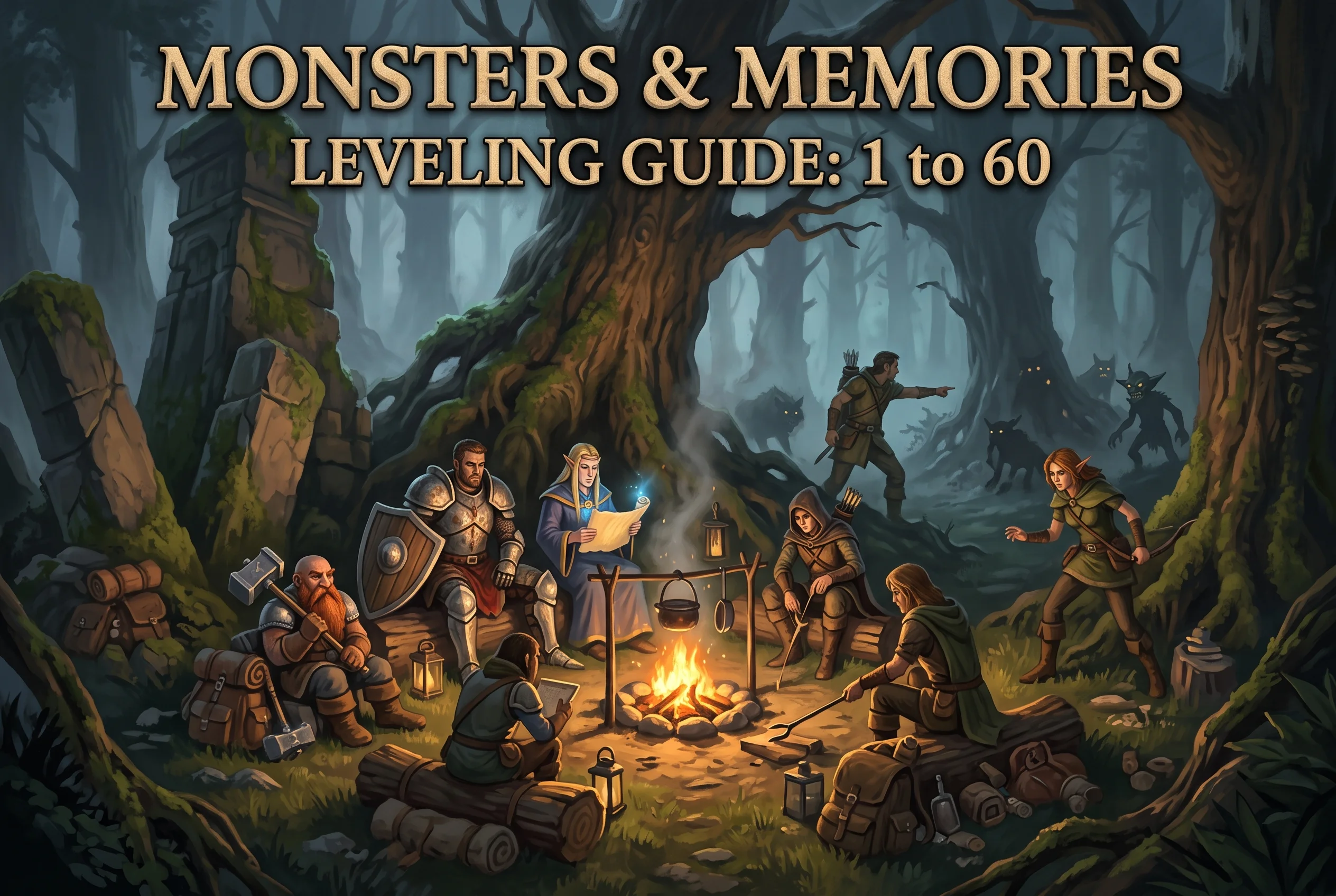
Monsters & Memories Leveling Guide: 1-60 Tips
Monsters & Memories Leveling Guide: A Practical Route from 1 to 60
Leveling in Monsters & Memories is not simply a matter of finding stronger monsters and repeating the same fight until your character gains another level. Your progress depends on where you hunt, how well your group works together, how much time you spend recovering, and whether your character is properly prepared for the next challenge.
A poor hunting location can turn a session into a series of difficult fights and long recovery periods. A good camp, on the other hand, lets your group maintain a steady pace without taking unnecessary risks. Knowing when to stay, when to move, and when to look for a party is often more valuable than chasing the highest-level enemies you can find.
This guide covers a practical approach to reaching level 60 in Monsters & Memories, including camp selection, suggested hunting areas, group experience restrictions, rested XP, and the mistakes that can slow down your progression.
The game remains in Early Access as of October 2026. Level ranges, class balance, and individual hunting recommendations may change with updates, so use the suggestions below as a starting point rather than a guaranteed route for every character.
Prepare Your Character Before Starting the Grind
Your first priority should be making sure your character is ready to fight consistently. Spending time on preparation at the beginning can prevent repeated trips back to town and help you avoid fights that become unnecessarily difficult.
Start by reading the note in your inventory and visiting your class guild master. This introduces you to your class, its starting quests, ability training, and the scrolls used to learn new skills. Make training part of your regular leveling routine instead of waiting until you are several levels behind.
Abilities are learned by scribing their scrolls and then memorizing the skills you want to use. You can keep up to 10 abilities memorized at once, which means your selection matters. A character heading into a solo encounter may need a different setup from one joining a party for extended hunting sessions.
Casters should pay particular attention to their spell selection and recovery needs. True caster classes gain their first cantrip at level 4, and these spells remain memorized through death. As you progress, review your available spells regularly rather than assuming your starting setup will continue to work everywhere.
Before leaving town, carry enough food and water, keep some money available for training, and bring a light source for nighttime travel. If your party plans to hunt far from a settlement, these supplies become even more important because unnecessary trips back to town can interrupt your progress.
Claim your first-visit discount now
Choose Camps by Efficiency, Not Just Monster Level
The most important leveling decision is choosing the right hunting camp. Monsters & Memories uses a shared-world approach in which groups hunt in open areas rather than relying on private instances for their regular progression.
A camp is a location where a party repeatedly fights suitable enemies. Usually, one player pulls an enemy toward the group, allowing the others to fight from a more controlled position. After the encounter, the party recovers and prepares for the next pull.
The best camp is not necessarily the one with the strongest enemies. Consider four things before settling into a location: how safely your group can defeat its targets, how long each encounter takes, how much recovery is needed afterward, and whether there are enough enemies to maintain a consistent pace.
If your group spends most of its time recovering, the camp may be too difficult. If the enemies disappear quickly but provide little useful progression, it may be time to look elsewhere. A location that initially works well can also become less attractive when other groups arrive or the available enemies no longer suit your party.
You can use the consider command with the C key to assess a target before attacking. Make this a habit when entering unfamiliar areas, especially when your group is approaching the upper end of its current hunting range.
A simple way to compare locations is to pay attention to how much progress your character makes over a consistent period of hunting. Include travel, deaths, recovery, and time spent searching for enemies in your assessment. A camp that delivers slightly less experience per kill may still be the better choice if your party can maintain a much steadier rhythm.
Where to Hunt as You Level
There is no official, fixed leveling route that every character must follow from level 1 to 60. Community hunting lists offer useful starting points, but the recommended ranges overlap because different classes and group compositions can handle the same enemies differently.
The table below summarizes community-reported camps from a player-maintained hunting list last updated in September 2026. These are suggested group ranges, not developer-confirmed level requirements.
Approximate group level | Areas worth exploring |
|---|---|
1-5 | Night Harbor and Evershade Weald starting areas |
6-16 | Tomb of the Last Wyrmsbane entrance, Shaded Dunes near Ashira, Tel Ekir |
13-23 | Ancient Crypt, Fallen Pass pit, Glass Flats goblins, Sungreet Strand quarry |
22-35 | Vale of Zintar, Scarwood, Sungreet Strand cellar and pirates, Keeper's Bight poachers, Grain Cellar |
30-48 | Fallen Pass Plagueborn and Skri'Var camps, Shallow Shoals basilisks and Orc Fortress, Glass Flats cultists |
45-60 | Glass Flats undead tower, Fallen Pass Saman, Vale of Zintar Giant City |
Treat this list as a shortlist of places to investigate, not an instruction to move at a particular level. Before traveling, ask other players about the current state of the camp and confirm that your party can handle the enemies there.
The cost of reaching a location matters too. If a camp requires a long journey through dangerous territory, make sure the expected improvement justifies the trip. This is particularly important when a group is replacing an established camp that already provides reliable experience.

Why Some Levels Take Longer
Do not assume that every level will take the same amount of time. Monsters & Memories has been designed around deliberate progression, and beta patch notes identified unusually demanding levels, commonly called hell levels, at 24 and 29. Additional levels may also take longer than the ones around them.
These figures come from beta-era information and should not be treated as an immutable list for every future build. Nevertheless, they illustrate an important point: slower progress does not always mean you are doing something wrong.
When a level starts taking longer, review your hunting location and your group's downtime before making major changes. A modest improvement in consistency can be more useful than repeatedly abandoning camps in search of a perfect spot.
Make Rested Experience Part of Your Routine
Rested experience is one of the most practical ways to improve your overall leveling efficiency. Resting near a campfire or inside an inn grants a 15% experience bonus while the Rested effect is active.
You do not need to spend a long time preparing this bonus. Under the published Early Access rules, around two minutes of resting can build up to 20 minutes of accumulated rest. Rain interrupts accumulation when you are exposed, but sheltered locations let you continue building rest in poor weather.
To make a campfire in the field, you need the Survival skill and eight pieces of wood. This makes it possible to create a recovery point close to your chosen hunting location instead of returning to town whenever you want to rest.
The useful approach is to make this part of your group's normal routine. Establish a campfire before a long session, recover between pulls when necessary, and take advantage of rested experience when the effect is available. Rangers also have class-specific campfire tools, including Hearth of the Ranger and Recuperate, which provides group recovery at a campfire on a long cooldown.
Rested XP does not compensate for an unsuitable camp, but it makes efficient hunting sessions more productive. It is a straightforward bonus worth incorporating into your progression plan.
Group Experience Rules You Need to Know
Groups are central to Monsters & Memories, and joining a party can open up hunting locations that would be much harder to handle alone. However, inviting characters of very different levels does not guarantee that everyone will receive experience from every kill.
Until level 15, group members generally need to be within five levels of the highest-level character to earn experience. After that, a character must be at least two-thirds of the highest-level member's level.
For example, a level 30 character can group with a level 20 character and remain within the experience rules. At level 60, the minimum eligible character level under the two-thirds rule is 40.
Check this before committing to a long session with friends or joining a higher-level party. A character who falls outside the permitted range may miss out on the experience you expected them to receive.
To find a suitable group, press O to open the Social window and select Group Finder. You can look for existing parties or list your own group with a desired level range, classes, roles, and objective. The /lfg on command can also indicate that you are looking for a group in player searches.
What Makes a Good Leveling Party?
A successful party needs more than high damage. Members should be able to handle the chosen enemies while limiting unnecessary deaths and recovery time.
Tanks and durable frontline characters help manage incoming damage, healers support survival, and damage dealers shorten encounters. Classes with pulling or crowd-control abilities can help the party handle enemies in a more controlled way. Support abilities that improve mana recovery can also be valuable during longer sessions.
The exact combination depends on the available classes and the camp. Focus on building a group that can repeatedly handle the enemies in front of it, rather than filling every role according to a rigid template.
Communication is equally important. Agree on who pulls, how the group handles additional enemies, and when to stop attacking and recover. A party that works well together can maintain consistent progress without relying on risky pulls.
Can You Reach Level 60 Solo?
Solo leveling is possible, but it depends heavily on your class and how you choose your opponents. Druids and Necromancers are among the classes highlighted by the developers for their solo potential, while other classes generally benefit more from group support.
If you prefer solo play, focus on manageable enemies and predictable encounters. Avoid targets that consume too much of your health or mana, and do not move to a tougher camp simply because your current opponents have become familiar.
Solo play also gives you more control over your schedule. You can stop whenever necessary, explore at your own pace, and avoid waiting for a full party to assemble. The trade-off is that some enemies and locations may be inefficient or unsafe without help.
For many players, alternating between solo activities and group hunting is a reasonable way to progress. Use the activities that suit your class and circumstances rather than treating solo or group play as the only valid option.
Avoid Losing Time After a Death
Death is particularly disruptive when your group is far from a safe area. Your character respawns at its bind point, while your belongings remain on your corpse. Recovering them may require traveling back through the same dangerous zone where the death occurred.
Corpse timers differ according to your level and whether the corpse contains items. Under the published rules, a level 1 corpse containing items lasts two hours, while item-bearing corpses for levels 2 and above have longer timers. Empty corpses follow different time limits, so check the current game rules rather than assuming every corpse expires at the same time.
Casters have another reason to prepare carefully. Their spellbooks remain on their corpses, and most memorized spells are cleared after death, although cantrips are retained. This can make an otherwise simple return journey more awkward.
Some resurrection abilities restore lost experience. Clerics have the Redemption line, while Paladins gain Revival at level 56. The exact benefits depend on the ability, so do not plan around resurrection as a substitute for avoiding unnecessary deaths.
If your party repeatedly dies at the same location, reconsider the camp instead of immediately repeating the same approach. A slightly easier route with fewer interruptions may lead to better overall progress than a dangerous one that occasionally produces a faster kill.
Supplies, Carrying Weight, and Travel
Small preparation mistakes can create avoidable delays during long sessions.
Keep food and water available because the Hungry and Thirsty states reduce health and mana recovery. Make sure you have a candle, torch, or lantern when traveling at night, and learn enough of the surrounding area to return to your camp without relying entirely on other players.
Pay attention to carrying weight, too. Becoming Encumbered reduces movement speed and prevents you from using gate or teleport abilities. If your party intends to travel with a Druid or Wizard, excessive weight can complicate the journey.
Monsters & Memories does not provide a conventional in-game world map. Learn important landmarks, remember entrances and zone boundaries, and ask guards for directions when necessary. Sense Heading and the Polar Alignment: North spell can help with orientation.
Navigation is not simply a convenience when leveling. Knowing where you are going can reduce wasted travel time, make it easier to join a group, and help you recover your belongings after an unsuccessful encounter.
A Simple Plan for Your Next Leveling Session
Before beginning another long session, check that your character is trained, your memorized abilities suit the activity, and you have the supplies needed for the trip. Make sure your group meets the experience restrictions and decide where you intend to hunt before leaving town.
Once you reach the camp, test the enemies carefully and establish a sustainable pace. Use rested experience when available, pay attention to how much recovery the party needs, and change locations if deaths or downtime begin to outweigh the benefits.
If progress slows, identify the actual problem before making a change. The camp may be too difficult, the party may lack an important role, or the group may be spending too much time traveling and recovering. Each problem calls for a different solution, and blindly moving to higher-level enemies may not fix any of them.
Finally, keep your expectations realistic. Reaching level 60 is a long-term goal, and a slower level does not necessarily indicate a failed strategy. Consistent progress, sensible decisions, and avoiding unnecessary setbacks are the foundations of efficient leveling in Monsters & Memories.
Monsters & Memories Leveling FAQ
How long does it take to reach level 60?
There is no reliable single completion time for every character. Progress depends on your class, hunting location, group availability, experience bonuses, and the amount of time you can play. The game is designed around deliberate progression, so reaching the cap requires a sustained investment.
What is the best leveling spot in Monsters & Memories?
The best location depends on your group's level and capabilities. Community hunting recommendations include the starting areas around Night Harbor and Evershade Weald, followed by areas such as Ancient Crypt, Scarwood, Fallen Pass, and Glass Flats at higher levels. Verify the current conditions before committing to a camp.
Does rested XP increase experience gained?
Yes. The Rested effect provides a 15% experience bonus. You can accumulate up to 20 minutes of rest in approximately two minutes near a campfire or inside an inn under suitable conditions.
Is group leveling better than solo leveling?
Group leveling opens up more options and can make dangerous camps safer and more consistent. Solo play remains viable for certain classes and situations. Choose based on how efficiently your character can defeat enemies and recover between encounters.
What level can join a level 60 group and gain experience?
Under the published group experience rules, a character must be at least level 40 when grouping with a level 60 character. Earlier in progression, the restriction is different: until level 15, characters generally need to be within five levels of the highest-level group member.
How do I find a party for leveling?
Open the Group Finder from the Social window by pressing O. You can browse available groups or list your own party. The /lfg on command also tells other players that you are looking for a group.
Spend Less Time on the Grind
Monsters & Memories rewards players who take the time to learn their class, find productive hunting locations, and work well with others. But reaching the content you want to experience can take a substantial amount of time, particularly when your available playtime is limited.
If you would rather move through the leveling process without spending every session on repetitive hunting, explore our Monsters & Memories leveling services. Choose the progression that fits your character and goals.
For a more direct option, visit our Monsters & Memories Character Leveling Boost. Our service is designed around careful progression, appropriate hunting routes, and regular updates through your order chat.
For the latest mechanics and official changes, consult the Monsters & Memories New Player Guide and the official game updates. Always verify community-recommended camps against the current Early Access version before traveling.