Valorant Ranks in Order: Iron to Radiant Explained
Valorant Ranks in Order: Every Tier from Iron to Radiant Explained
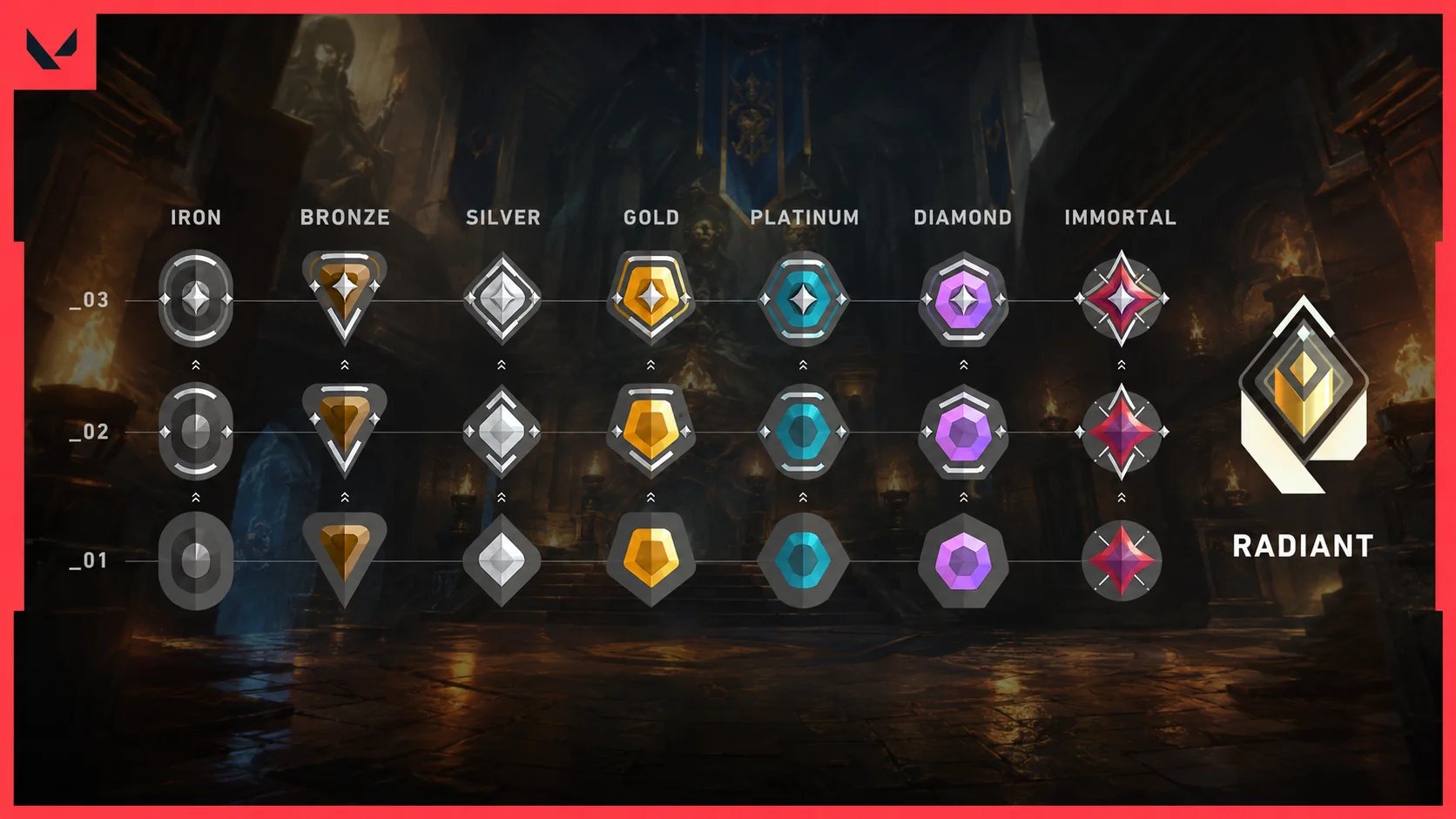
Valorant's ranking system looks simple from the outside: nine ranks, climb from the bottom to the top. In practice it's a bit more layered than that, with 25 distinct rungs on the ladder, a hidden skill rating working behind the scenes, and rules around promotion and demotion that trip up a lot of players who've never had them explained clearly. This guide walks through the full rank order, how Rank Rating actually moves, and what it takes to reach Immortal and Radiant.
Rank Tiers in Order
Rank | Sub-Tiers | Total Levels |
Iron | Iron 1, Iron 2, Iron 3 | 3 |
Bronze | Bronze 1, Bronze 2, Bronze 3 | 3 |
Silver | Silver 1, Silver 2, Silver 3 | 3 |
Gold | Gold 1, Gold 2, Gold 3 | 3 |
Platinum | Platinum 1, Platinum 2, Platinum 3 | 3 |
Diamond | Diamond 1, Diamond 2, Diamond 3 | 3 |
Ascendant | Ascendant 1, Ascendant 2, Ascendant 3 | 3 |
Immortal | Immortal 1, Immortal 2, Immortal 3 | 3 |
Radiant | Top 500 Regional Leaderboard (No subdivisions) | 1 |
Claim your first-visit discount now
Competitive Rules
Rule Category | Description & Requirements |
Unlocks | You must reach account level 20 and play 20 unrated matches before queuing for competitive. |
Placements | New accounts require 5 placement games to earn an initial rank (capped at Ascendant 3). |
Leaderboards | Immortal and Radiant players appear on public regional leaderboards. |
Inactivity | If you do not play a competitive match for 14 days, your rank icon becomes hidden until you play one match. |
Every Valorant Rank, Low to High
From the bottom of the ladder to the top, the nine ranks are Iron, Bronze, Silver, Gold, Platinum, Diamond, Ascendant, Immortal, and Radiant.Ascendant is the one people tend to forget exists, mostly because it's a relatively recent addition. Riot added it in June 2022 to break up a player base that had gotten too crowded in the lower and middle ranks, giving players between Diamond and Immortal more room to spread out instead of everyone getting stuck fighting over the same narrow band.


Why There Are 25 Ranks, Not 9
Every rank except Radiant is split into three tiers, written as a number after the rank name: Gold 1, Gold 2, Gold 3, and so on. Multiply that out and you get eight ranks times three tiers, plus Radiant sitting on its own with no subdivisions, for 25 total rungs on the ladder.Radiant doesn't need tiers because there's no room to split it further. It's already the smallest group in the game by a wide margin.
How Rank Rating Actually Works
Below Immortal, your progress inside a tier is tracked by Rank Rating, or RR, on a scale from 0 to 100. Hit 100 and you get promoted to the next tier. A few things about how it moves aren't obvious until you've climbed for a while:
Wins and losses are what move RR the most, but they're not the whole story. How decisively you won, standout individual performances, and whether you were the underdog in the matchup all factor in on top of the base result. Your hidden matchmaking rating (MMR) sets the pace behind all of this. If your MMR is sitting above your visible rank, you'll gain more RR per win than you lose per loss, since the system is actively trying to push you toward where it thinks you actually belong.
Demotion isn't as harsh as people assume. A single bad game at 0 RR won't drop you a tier. You have to hit 0 and then lose again before you actually fall. Promotions come with a small cushion too: you start a new tier with at least 10 RR already banked, and if you do get demoted, you're never dropped below 70 RR in the tier you land in.
Getting to Immortal and Radiant
Immortal and Radiant work differently from everything below them. RR stops resetting at 100 and instead keeps accumulating for as long as you keep winning. At this level, RR becomes purely about outcomes. The margin-of-victory and standout-performance bonuses that help you climb in lower ranks don't apply anymore, so it comes down to wins and losses alone.
Radiant adds a second requirement on top of that: you need to clear your region's RR threshold and also hold a spot among the very top players in that region, generally described as the top 500. Climbing through the Immortal tiers depends on region-specific thresholds too, which Riot adjusts periodically. Holding a leaderboard spot at Immortal or Radiant also requires playing at least one competitive match every 7 days, or your position can slip even without a loss.
Placement Matches and Soft Resets
Every time the season resets, players go through placement matches to re-establish where they land on the ladder. At the start of a season and again at its midpoint, that means 5 placement matches, and the highest you can place out of them is Ascendant 1, no matter how high you finished the previous act. The other acts within a season only require 1 placement match, since your rank and MMR carry over from before as a soft reset rather than starting from scratch.
That soft reset is why strong players tend to climb back to their old rank quickly after a reset. The system already has a good read on their skill from the prior act and doesn't make them prove it from zero again.
Grinding through 5 placement matches at a real risk of landing lower than you'd like is exactly the kind of thing some players would rather hand off entirely. misti.services runs placement matches with experienced players handling the games, aimed at getting you the strongest possible starting position for the act.
No Rank Decay
One piece of good news for anyone who takes breaks: Valorant doesn't have rank decay. Your rank stays exactly where you left it if you stop playing for a stretch. The only time-sensitive requirement in the whole system is that 7-day window for Immortal and Radiant leaderboard positions, and that's about your spot on the leaderboard specifically, not your underlying rank.
Seasons, Acts, and Unlocking Competitive
Since January 2025, Valorant has run on year-long Seasons made up of six Acts, each lasting roughly two months. Competitive resets twice per season: once at the very start, and once at the midpoint. Each Act also tracks its own Act Rank separately, based on your best wins during that specific act rather than your overall season performance.
Before any of this applies to you, there's one gate to clear first. Competitive mode unlocks at Account Level 20, which you build up by playing Unrated and other non-competitive modes. Everything below that level is about learning the game, not climbing a ladder.
Ready to Climb Faster?
Whether you're stuck grinding out of a rank that doesn't reflect your actual skill or you just want a stronger placement result at the start of a new act, misti.services offers Valorant boosting handled by experienced players on every server.