WoW Forever Beginner Guide: Start Your Adventure
WoW: Forever Beginner Guide: Everything You Need to Know Before Starting
Starting a new character in World of Warcraft: Forever is an opportunity to explore a familiar world with a different set of possibilities. The game retains the original level 60 progression structure while introducing new questlines, expanded zones, additional dungeons, updated class mechanics, and systems that create more reasons to keep developing your character after reaching the level cap. Whether this is your first experience with World of Warcraft or you have spent years playing Classic, understanding the fundamentals will help you avoid common mistakes and make your early hours in Azeroth more rewarding.
WoW: Forever launches on November 4, 2026, at 3:00 p.m. Pacific Time. Before entering the world, you should understand the available rulesets, decide which faction you want to join, choose a class that fits your preferred playstyle, and learn how progression differs from modern World of Warcraft. These decisions are important because some affect which players you can group with, while others determine how comfortably you level and how much preparation you will need for endgame content.
This beginner guide covers the essentials, from setting up your first character to understanding combat, equipment, professions, travel, and group activities. The goal is to help you build a solid foundation without turning your first adventure into a checklist that leaves no room for exploration.
Getting Started With WoW: Forever
To begin playing, you need a Battle.net account and an active World of Warcraft subscription or available Game Time. Install the Battle.net desktop application, sign in, install World of Warcraft, and select WoW: Forever from the available game versions. Check the current system requirements before downloading the game, particularly if you are using an older computer.
Controller support is also available in beta, although keyboard and mouse remain the conventional setup for many players. Your initial interface configuration deserves attention because comfortable key bindings, clear action bars, and readable quest objectives make combat and navigation easier to learn.
The first time you enter the game, you will encounter two experience presets: Classic and Enhanced. Classic provides a more traditional presentation, with fewer modern interface conveniences enabled by default. Enhanced includes features such as high-definition character models, more visible quest objectives, a consolidated bag interface, and transmog enabled by default. Neither preset permanently locks you into its configuration, so you can adjust individual settings later.
For players who are unfamiliar with the game or simply want a more convenient starting point, Enhanced is a practical choice. Veterans who prefer a more traditional interface may feel more comfortable with Classic. Character model quality can also be selected individually when creating a character, allowing you to choose the appearance you prefer without changing character abilities or progression.
Before continuing, familiarize yourself with the Options menu. Configure your movement keys, action bars, camera controls, nameplates, and audio to suit your preferences. Spending a few minutes on these settings can save frustration throughout the leveling process.
Claim your first-visit discount now
Choosing the Right Ruleset
One of the most important decisions comes before character creation. WoW: Forever offers several rulesets, each designed around a different way of experiencing Azeroth. Unlike a purely cosmetic choice, your ruleset affects how you interact with other players and which communities you can join.
Normal is the most approachable option for players who want to explore, complete quests, develop professions, and fight monsters without making open-world PvP the central part of their adventure. It suits beginners who want to learn the game at their own pace, as well as returning players who prefer a more relaxed environment.
PvP is intended for players who enjoy the risk of fighting members of the opposing faction throughout much of the open world. Traveling between quest hubs can become more unpredictable, and competition for territory adds another dimension to leveling. This is a good choice for players who enjoy player-versus-player combat and want that possibility to be part of their regular experience.
Roleplay supports players who want a more immersive world, with additional community expectations surrounding character names and behavior. It can be appealing if you enjoy developing a character's identity, participating in roleplaying events, and interacting with people who approach Azeroth as more than a combat system.
Roleplay-PvP combines roleplaying conventions with the danger of open-world conflict. It suits players who want an immersive environment while accepting the additional risks associated with PvP.
Hardcore is planned for a later release rather than being available at launch. Its defining feature is the heightened consequence of character death, making every encounter and travel decision more significant.
There is one rule worth remembering before you decide: characters can group, join guilds, enter dungeons, and raid only with players who share their faction and ruleset. If you are planning to start with friends, settle these choices together before creating your characters. Otherwise, you could discover that your new characters cannot play together as expected.
Choosing Your First Class and Race
Your race and class determine much of how your character experiences the game. Your race influences your starting location, racial abilities, and available character options, while your class defines your primary combat tools and potential group roles.
For a first character, it is usually more important to select a playstyle you enjoy than to chase a theoretical damage ranking. A class that feels comfortable during ordinary questing will help you learn combat, manage resources, and understand the world without constantly struggling against its mechanics.
Hunters are an appealing option for players who prefer ranged combat and pet assistance. A pet can help manage enemy attention, giving the Hunter more room to deal damage while learning encounters. This can make solo questing more forgiving.
Mages offer ranged spellcasting, crowd control, and the ability to deal with multiple enemies when played carefully. They can be extremely effective, but their limited durability makes positioning and understanding enemy abilities important. Players who enjoy tactical combat and magical damage may find the class rewarding.
Druids provide flexibility through different forms and combat roles. Their ability to adapt to different situations makes them interesting for players who do not want to be restricted to one style of play. Paladins also offer valuable versatility, combining durability, supportive abilities, and several ways to contribute to groups.
Warriors can be satisfying for players who prefer direct melee combat, while Priests offer a natural introduction to healing alongside their offensive options. Rogues reward players who enjoy controlled engagements and careful use of their abilities. Shamans and Warlocks provide their own mixtures of damage, utility, and resource management.
These are general playstyle considerations, not a definitive ranking of the strongest classes. Class balance can change, and the best choice for leveling may differ from the best specialization for raiding or PvP.
WoW: Forever also introduces the Skyborne as a new race option. Skyborne characters begin on Zephras Isle, a starting area designed for levels 1 to 12. Horde-aligned Skyborne can become Shamans, while Alliance-aligned Skyborne can become Mages. Access to the race requires the Heroic Pack or a higher digital upgrade.
Take the time to read the available class and racial descriptions before committing to your first character. The early levels are an opportunity to discover what feels right, and you do not need to select a class solely because someone else recommends it.

Top-Tier WoW:Forever Services
Honor Boost
Secure the exact Honor Points you need in WoW:Forever without the grind. Our service ensures swift rank progression and valuable PvP rewards.
Pre Raid Gear
Pre Raid Gear in WoW:Forever is essential for gaining access to high-stakes raids, requiring players to meet strict gear standards. This service includes acquiring dungeon drops, crafted items, and reputation rewards, ensuring your character is fully equipped and raid-ready.
Professions Kits
Professions Kits in WoW:Forever are essential for mastering professions like Alchemy and Blacksmithing, providing materials to reach level 300 seamlessly. These kits include rare crafting items and a detailed guide, helping players create high-value gear and dominate Azeroth's economy.
Understanding Your First Quests
Once you enter Azeroth, quests will become the foundation of your progression. Characters with exclamation marks above their heads generally have quests available, while question marks indicate objectives that are ready to turn in. Accepting quests adds them to your Quest Log, where you can review their objectives and track the activities you are currently pursuing.
The map and minimap help you locate objectives, but questing is not simply a matter of following markers. Pay attention to the levels of nearby enemies, the distance between objectives, and whether several quests can be completed during the same trip. Grouping nearby objectives together reduces unnecessary travel and makes your time in each zone more productive.
Read quest descriptions when possible. They can explain why you are visiting a location, introduce characters you will meet later, and sometimes reveal details that make an objective easier to understand. WoW: Forever includes more than 1,000 new quests across the level 1 to 60 journey, so even experienced Classic players will have opportunities to explore unfamiliar content.
Avoid feeling obligated to complete every quest you encounter. Some objectives are optional, some are more appropriate for groups, and others may send you far away from your current area. If a quest becomes too difficult or inefficient, consider returning later or continuing with nearby objectives instead.
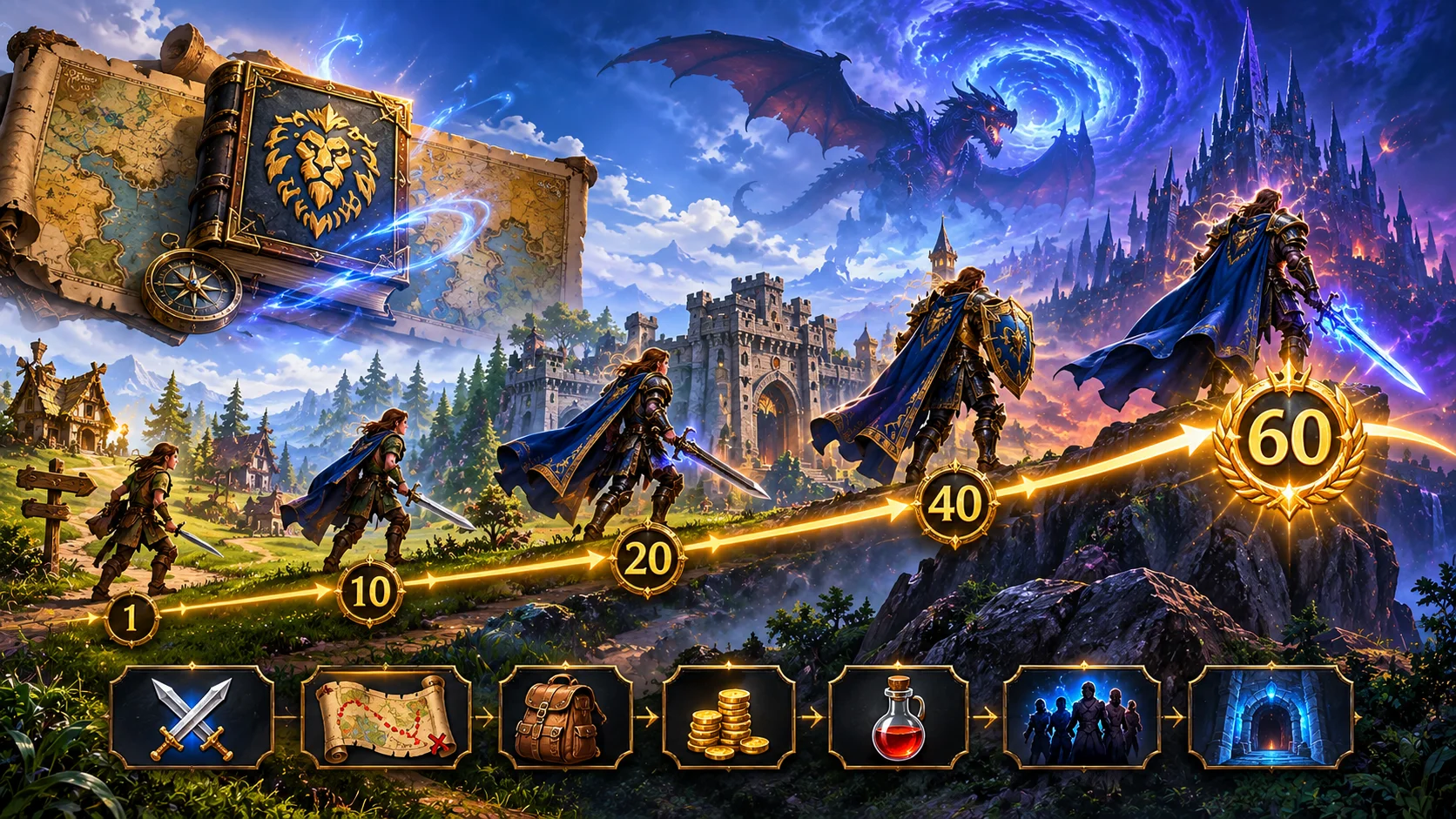
For a more structured route through the early and later levels, use the WoW: Forever 1-60 leveling guide. It covers progression zones, dungeon opportunities, and ways to reduce unnecessary travel as you move toward level 60.
Learning Combat Without Wasting Time
Combat becomes much easier once you understand your abilities, resource management, and the importance of choosing your engagements carefully. Your action bars hold the skills you use most frequently, while the Spellbook provides a list of abilities your character has learned. Read ability tooltips before assuming that two skills serve the same purpose, and visit your class trainer as you progress to learn new abilities and ranks.
When you are still learning a class, fight one ordinary enemy at a time. Watch your health, mana, energy, rage, or other class resources, and use defensive abilities when a situation begins to deteriorate. Pulling several enemies simultaneously can be efficient for some builds, but it is rarely the best way to learn unfamiliar mechanics.
Food and drink can reduce downtime between fights, particularly for characters that rely on mana. Bind your Hearthstone to a useful inn, and make sure you have a sensible return point before traveling into unfamiliar territory. These small habits become increasingly valuable as the distance between quest objectives grows.
Death is part of the leveling experience, especially when exploring an unfamiliar zone. After releasing your spirit, use the corpse marker to locate your body and resurrect when you are close enough. A Spirit Healer provides an alternative when recovering your corpse is impractical, but spirit resurrection can damage equipment durability and may inflict Resurrection Sickness. Repair your gear afterward and avoid returning directly to difficult combat while the debuff remains active.
The most useful early habit is to understand why a fight went wrong. Check whether your equipment was outdated, an enemy was too powerful, or you used abilities inefficiently. Small adjustments can make your next attempt much easier.
Managing Equipment, Bags, and Gold
Equipment progression starts well before the level cap. Quest rewards, enemy drops, dungeon encounters, and crafted items all contribute to improving your character. However, a higher item quality does not automatically make an item the correct upgrade. Look at the attributes your class actually benefits from, check weapon compatibility, and consider whether new armor will provide a meaningful improvement to your survivability.
Replace particularly weak equipment when a worthwhile upgrade becomes available, but do not waste all your gold chasing small improvements that will soon be replaced. Your early currency has several important uses, including ability training, bags, repairs, travel expenses, and profession development.
Bag space can become a problem as you collect quest rewards and crafting materials. Sell unwanted items to vendors, keep useful materials organized, and use your bank for items you intend to save. Items with gray-quality names are generally vendor trash, making them a straightforward way to recover some of your expenses.
Saving gold is particularly important as your character progresses. Training, equipment maintenance, profession materials, and consumables can all compete for the same limited resources. Avoid buying every item that looks interesting before understanding whether it contributes to your next progression goal.
Our WoW Forever gold guide covers how to build and manage your currency while leveling. For equipment planning, the WoW Forever gear guide explains how quest rewards, dungeons, crafting, and endgame preparation fit together.
Professions: What Should Beginners Learn?
Professions provide additional ways to develop your character, gather resources, craft equipment, and support other players. Each character can learn two primary professions, alongside all three secondary professions: Cooking, Fishing, and First Aid.
Gathering professions such as Herbalism, Mining, and Skinning can help you collect resources while completing ordinary quests. Instead of treating gathering as a completely separate activity, you can pick up useful materials as you travel through the world. This can supply your own crafting needs or provide items to sell later.
Crafting professions serve different purposes. Alchemy creates potions, Blacksmithing produces metal equipment, Enchanting improves gear, Engineering creates gadgets, Leatherworking makes leather and mail items, and Tailoring produces cloth gear and bags. The value of a profession depends on your class, equipment needs, available materials, and the game economy.
For a first character, gathering can be attractive because it lets you earn resources without making a large initial investment in crafting materials. However, a profession that supports your preferred equipment or consumables can also be a sensible long-term choice.
Cooking and First Aid help with general preparation, while Fishing can supply materials for other activities. You do not need to master every profession immediately. Start with combinations that fit your plans, develop them as you level, and avoid spending heavily on recipes you are unlikely to use.
Professions become more relevant as you approach level 60, when crafted equipment and consumables can support dungeon runs and endgame preparation. Learning the basics early makes that transition easier.
Traveling Around Azeroth Efficiently
Travel is one of the hidden factors that affects how quickly you progress. Even a strong character can lose a significant amount of time by repeatedly crossing the same zones or traveling to distant quest objectives without a clear plan.
Flight masters are essential for reducing unnecessary travel. Whenever you reach a new settlement with a flight master, speak to them and unlock the available flight path. You may not need to use every route immediately, but having it available later can save substantial time.
Your Hearthstone serves as another important travel tool. Bind it to an inn that makes sense for your current progression, then reconsider the location when your activities shift to another region. The ideal bind point is often determined by your quest route, access to services, and the distance to your next objectives.
Ships, zeppelins, and other travel connections can help you reach distant regions. Learn the routes that connect your faction's major settlements and avoid assuming that every destination can be reached directly. Planning a trip around nearby quests and unlocked flight paths is usually more efficient than traveling repeatedly for individual objectives.
The new and expanded content makes route knowledge especially valuable. Riverglades, Shen'Dralas, and other destinations offer reasons to move beyond familiar Classic routes. Our WoW Forever travel guide explains major travel connections, ships, and flight paths in more detail.
Dungeons and Group Play for Beginners
Dungeons introduce a different kind of progression from ordinary questing. They require several players to cooperate against stronger enemies and bosses, often rewarding the group with equipment, quest experience, and useful items. Dungeons can be an excellent way to learn your role, but joining without understanding the basics can make the experience frustrating for everyone.
A conventional five-player group includes a tank, a healer, and damage dealers. The tank manages enemy attention and helps control the encounter, the healer keeps the group alive, and damage dealers focus on defeating enemies while avoiding unnecessary damage. Exact expectations depend on the group and its composition, but communication and awareness are important in every role.
Before joining a dungeon, ensure that you understand your main abilities and have enough room in your bags. Repair damaged equipment, bring appropriate food or drink, and ask about unfamiliar mechanics rather than guessing. If you are playing a tank or healer, explain your experience level when joining an unfamiliar group so the party can establish realistic expectations.
Do not assume that every dungeon is appropriate as soon as you reach its minimum level. Some encounters become much easier with a few additional levels, better equipment, or a more balanced group. Completing the associated quests before entering can also make a run more rewarding.
Grouping can help with difficult elite quests and enemies that are inefficient to defeat alone. It is also one of the best ways to meet other players and find a guild. Building those connections early can make later progression, profession development, and raid preparation considerably easier.
Campsites provide another opportunity to interact with people in the open world, share profession-related benefits, and prepare for future adventures. WoW: Forever is built around an evolving world, so these social activities are part of the experience rather than merely a way to reach the next level.
Avoid These Common Beginner Mistakes
One common mistake is choosing a ruleset without considering where your friends intend to play. Because ruleset and faction choices affect which players you can group with, decide on these before creating your character rather than discovering the restriction after several hours of leveling.
Another mistake is spending gold as quickly as it arrives. Early currency can disappear through training, unnecessary equipment purchases, and profession expenses. Keep enough available for essential upgrades and repairs, and avoid buying every item you find appealing.
Players also lose time by remaining in a zone after its quests have become inefficient. Since enemies and zones do not simply scale to match your character, progression depends on selecting appropriate areas. Move to a new region when the objectives become less rewarding or the enemies no longer offer a reasonable challenge.
Finally, do not chase endgame rankings before learning how your character works. Class tier lists and optimization discussions can be useful, but they do not replace understanding ability interactions, equipment choices, and your preferred role. A comfortable build with well-maintained equipment is a much better starting point than an unfamiliar setup copied from an advanced player.
Preparing for Level 60 and Beyond
Reaching level 60 is an important milestone, but it is not the end of character progression in WoW: Forever. The game continues with dungeons, raid preparation, PvP, professions, equipment improvements, and additional content as the world develops.
Start thinking about your preferred endgame activities before the final levels. Players interested in raiding should learn which equipment upgrades are worthwhile, maintain a reserve of gold for consumables and repairs, and consider the requirements of their intended role. Those who prefer PvP may want to explore their class's strengths against other players and develop a build that suits their preferred encounters.
The first announced raids, Barrow Deeps, Hyjal Summit, and Onyxia's Lair, are scheduled to unlock on December 9, 2026. Their different group sizes make it useful to plan ahead, particularly if you intend to play with a guild or regular group. Our WoW Forever raids guide covers the initial raid lineup and preparation requirements.
Players do not need to rush toward the level cap at the expense of learning the game. Understanding your class, building a stable economy, unlocking travel connections, and making friends will all help you progress more smoothly once the first major endgame challenges become available.
Is WoW: Forever Worth Starting as a New Player?
WoW: Forever offers a different proposition from a game that constantly increases its level cap. The level 60 framework preserves a sense of character progression while expanded zones, new quests, and additional systems create more room to explore. Returning players can rediscover familiar regions, while newcomers can learn the fundamentals without needing years of previous experience.
The best way to begin is to choose a ruleset that matches your preferences, pick a class you genuinely enjoy, and build your knowledge as you explore. Learn the basics of combat, manage gold carefully, unlock flight paths, and treat equipment and professions as ongoing parts of progression. You will make mistakes along the way, but most early setbacks are opportunities to understand the game better.
For players who want to spend more time on the activities they enjoy and less time on repetitive progression, misti.services WoW: Forever services include leveling, gold, professions, PvP, and pre-raid gear options. Whether you progress independently or seek assistance with specific goals, the aim is to build a character you are ready to take into the next stage of Azeroth.
Every new adventure begins with a few simple decisions. Choose your path, learn the world at your own pace, and give yourself room to discover what makes WoW: Forever worth playing.