MapleStory Classic Fire/Poison Wizard Guide: Best Build, Skills & Leveling
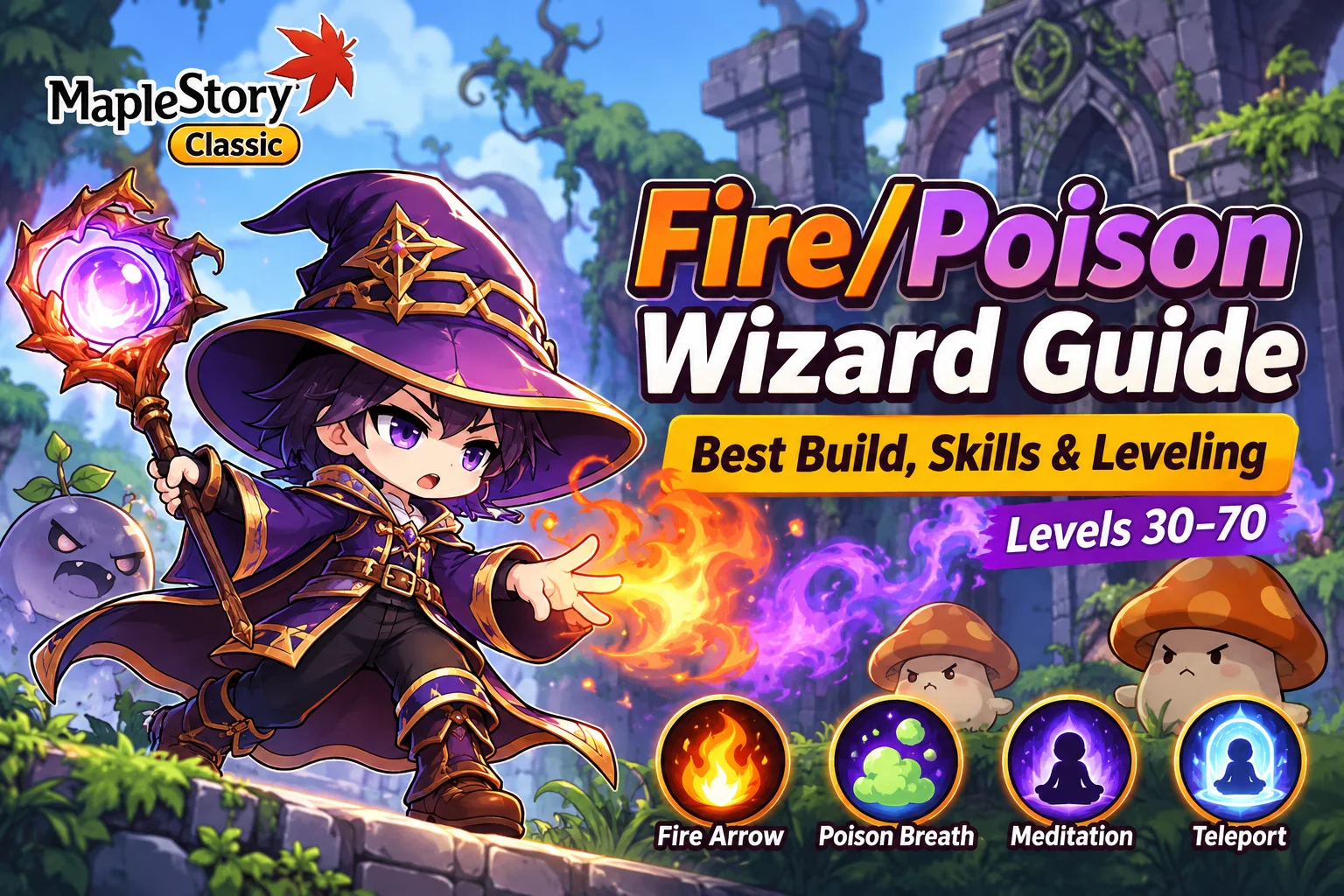
MapleStory Classic Fire/Poison Wizard Guide: Best Build, Skills & Leveling
The Fire/Poison Wizard is one of the most interesting second-job choices for Magicians in MapleStory Classic. Instead of relying on a single type of spell, this class combines powerful fire attacks, poison damage over time, party support and excellent mobility. Fire Arrow provides reliable single-target damage, while Poison Breath can damage several enemies with one explosion.
The class becomes particularly effective when you understand elemental weaknesses and choose your training locations accordingly. A Fire/Poison Wizard fighting fire-weak monsters can perform considerably better than one using the same skills against resistant enemies. However, inefficient spell usage and poor MP management can quickly make leveling expensive.
This guide covers the complete progression from level 30 to 70, including the recommended skill build, AP distribution, equipment upgrades, training locations and important combat mechanics. It also accounts for the November 2026 update, which introduced Forgotten Hollow and changed spawn rates across several existing training maps.
Fire/Poison Wizard Overview
The Fire/Poison Wizard specializes in elemental damage and damage-over-time effects. Its two main offensive abilities serve different purposes, making it important to understand when to use each one.
Category | Details |
|---|---|
Job progression | Magician → F/P Wizard → F/P Mage |
Second job | Level 30 |
Primary stat | Intelligence (INT) |
Secondary stat | Luck (LUK) |
Weapons | Wands and staves |
Main single-target skill | Fire Arrow |
Main multi-target skill | Poison Breath |
Important party skill | Meditation |
Level range covered | 30-70 |
Main strengths
Fire Arrow deals strong single-target damage and benefits from fire elemental weaknesses.
Poison Breath can damage up to six nearby enemies with its contact explosion.
Meditation increases Magic Attack for nearby party members.
Teleport provides excellent mobility across complicated training maps.
MP Eater can reduce the amount of money spent on MP potions.
Main disadvantages
Fire-resistant monsters reduce Fire Arrow damage and cannot receive its burn effect.
Poison Breath consumes 40 MP at maximum level.
Poison is ineffective against monsters resistant to that element.
Low HP makes careless Magic Guard usage expensive.
The class relies heavily on choosing the correct monsters and training locations.
Claim your first-visit discount now
Becoming a Fire/Poison Wizard
Your Magician can advance into a Fire/Poison Wizard once it reaches level 30 and completes the second-job advancement quest. Before starting, make sure your first-job skill allocation is complete because second-job skill points cannot be used on first-job abilities.
The advancement quest begins with Grendel the Really Old in Ellinia. Follow these steps:
Speak with Grendel the Really Old in the Ellinia Magic Library.
Take his letter to the Magician Job Instructor in The Forest North of Ellinia.
Complete the advancement test by collecting 30 Dark Marbles.
Exchange the marbles for The Proof of a Hero.
Return to Grendel and choose the Fire/Poison Wizard path.
Your first skill point as a new F/P Wizard should go into Teleport. Even at level one, it gives you access to useful movement options and makes navigating multi-platform maps easier.
However, level-one Teleport has a relatively high MP cost, so avoid using it constantly until you have invested more points into the ability.
Players who have not reached level 30 yet should first check our MapleStory Classic Magician Guide, which covers early skill progression, AP allocation and the equipment needed before your second job.
Best Fire/Poison Wizard Skill Build (Levels 30-70)
Your skill allocation determines how efficiently you can level throughout the second job. Fire Arrow and Poison Breath are your main damage abilities, but investing in them at the correct time is important because their effectiveness depends on monster density and elemental resistance.
The recommended general-purpose build prioritizes Fire Arrow, followed by Poison Breath, Meditation, MP Eater and Teleport.
Recommended SP allocation
Character Level | Skill Allocation | Result |
|---|---|---|
30 | Teleport +1 | Teleport 1 |
31-39 | Fire Arrow +27 | Fire Arrow 27 |
40 | Fire Arrow +3 | Fire Arrow 30 |
41-49 | Poison Breath +27 | Poison Breath 27 |
50 | Poison Breath +3 | Poison Breath 30 |
51 | MP Eater +3 | MP Eater 3 |
52-57 | Meditation +18 | Meditation 18 |
58 | Meditation +2, MP Eater +1 | Meditation 20, MP Eater 4 |
59-63 | MP Eater +15 | MP Eater 19 |
64 | MP Eater +1, Teleport +2 | MP Eater 20, Teleport 3 |
65-69 | Teleport +15 | Teleport 18 |
70 | Teleport +2, Slow +1 | Teleport 20, Slow 1 |
At level 70, this build provides maximum Fire Arrow, Poison Breath, Meditation, MP Eater and Teleport. Slow receives one point as the remaining utility skill.
Why max Fire Arrow first?
Fire Arrow is your most consistent offensive ability during the early second-job levels. It focuses on one enemy, deals substantial direct damage and applies a burn effect that continues damaging the target for three seconds.
The most important advantage is that Fire Arrow remains useful even when monsters are spread across a map. You do not need to group enemies together or rely on a successful multi-target explosion.
Poison Breath becomes much more attractive when you can consistently hit several enemies at once. Its explosion can reach up to six targets, but each individual hit deals considerably less direct damage than a maximum-level Fire Arrow.
The practical difference comes down to how many enemies you hit per cast. When Poison Breath consistently connects with three or more monsters, it can become the better damage option. When you are fighting one or two enemies at a time, Fire Arrow is generally the more efficient choice.
Another important detail is that Fire Arrow performs differently depending on elemental resistance. Against fire-weak monsters, it becomes effective at a considerably lower skill level. Against neutral monsters, Energy Bolt or Magic Claw can remain useful until Fire Arrow reaches a stronger damage breakpoint.
Alternative skill progression
The standard build works well for most players, but there are several situations where changing the order can improve your progression.
Prioritize Poison Breath first: If your training map has tightly grouped monsters and you can regularly hit three or more enemies with every cast, consider maxing Poison Breath before Fire Arrow. Its multi-target damage can outperform single-target attacks when the explosion consistently connects.
Prioritize Meditation: Players who mostly fight single targets can invest in MP Eater 3 after maxing Fire Arrow, then complete Meditation before returning to Poison Breath. This gives you a valuable Magic Attack increase earlier without rushing a skill that provides little benefit against isolated enemies.
Improve Teleport earlier: If you spend most of your time on maps with several platforms, additional Teleport levels can improve your movement and training efficiency. This is particularly useful when reaching enemies requires constant movement between different elevations.
The most important principle is to avoid spreading your skill points across several abilities without a clear purpose. Build your main attack first, then invest in the utility skills that support your preferred training style.
Fire/Poison Wizard AP Build: INT and LUK
Intelligence is your primary stat and should receive most of your ability points throughout the entire progression. It improves magical damage, contributes to your MP pool and increases your Magician accuracy.
Luck is mainly required to equip certain wands, staves and other equipment. You should only invest enough LUK to reach the requirements of your next planned upgrade, then return to Intelligence.
Remember that equipment can provide additional LUK. Your total LUK is calculated using both your base stat and the bonuses from equipped items. This means you do not always need to invest the full weapon requirement through AP.
Recommended stat distribution
Level Range | AP Priority | Purpose |
|---|---|---|
31-34 | INT +5 per level | Increase magical damage |
35 | LUK +5 | Prepare for the next weapon |
36-39 | INT +5 per level | Continue increasing damage |
40 | LUK +5 | Meet Fairy Wand requirements |
41-48 | INT +5 per level | Maximize offensive scaling |
49-50 | LUK +5 per level | Prepare for Cromi |
51-53 | INT +5 per level | Increase damage and MP |
54-55 | LUK +5 per level | Prepare for Thorns |
56-67 | INT +5 per level | Focus on main stat |
68 | INT +2, LUK +3 | Long-term weapon preparation |
69-70 | LUK +5 per level | Reach the level 70 equipment target |
The level 70 reference build finishes with approximately 299 INT and 63 base LUK, with additional LUK coming from equipment.
Do not blindly follow the table if you cannot currently obtain the corresponding equipment. The level 70 Angel Wings target requires 65 total LUK, but Ossyria and its higher-level content are not currently available. Keep your AP flexible and invest in equipment that you can actually use.
Weapon requirements
Level | Weapon | Required INT | Required LUK | Magic Attack |
|---|---|---|---|---|
30 | Mithril Wand | 60 | 20 | 55 |
35 | Wizard Wand | 70 | 25 | 62 |
40 | Fairy Wand | 80 | 30 | 69 |
45 | Arc Staff | 90 | 40 | 73 |
50 | Cromi | 100 | 40 | 83 |
55 | Thorns | 110 | 50 | 87 |
70 | Angel Wings | 140 | 65 | Not currently obtainable |
The weapon progression is relatively straightforward. Mithril Wand, Wizard Wand and Fairy Wand provide useful upgrades during the early second job, while Cromi is a particularly important improvement at level 50.
Arc Staff is another possible upgrade after the November crafting changes. However, it only provides four additional Magic Attack over Fairy Wand while requiring considerably more LUK. For a conventional build, that difference is generally not worth delaying Intelligence.
Best Equipment for Fire/Poison Wizards
Your equipment should primarily improve Magic Attack and Intelligence. Physical weapon attack is not a meaningful substitute for Magic Attack when calculating your normal spell damage.
Wands and staves can both be used with shields, so you should compare their actual Magic Attack rather than choosing an item based on its weapon type.
Recommended equipment priorities
Weapons: Upgrade when a meaningful Magic Attack improvement becomes available. Cromi is a particularly important level 50 milestone, while Thorns provides another upgrade around level 55.
Shields: Pan Lid is an interesting option because of its physical defense and Guard chance. Esther Shield is an alternative that provides additional Magic Defense, making it more useful in situations where magical attacks are a concern.
Armor: Look for mage robes and hats with useful INT and LUK bonuses. Level 30, 40 and 50 equipment checkpoints provide natural upgrade opportunities, but a cheaper item with better rolled stats can sometimes be more valuable than purchasing every available equipment tier.
Gloves: Magic Attack is generally the better choice for spell-focused builds. Lesser Gloves Magic Attack Scrolls provide +2 Magic Attack per successful scroll, while the corresponding Critical Rate scroll adds +1% Critical Rate. Prioritize Magic Attack rather than Weapon Attack when upgrading gloves for your spells.
Do not waste mesos chasing small equipment improvements that do not meaningfully change your damage or kill speed. A character with a well-planned weapon and sufficient accuracy can often outperform another character with more expensive but poorly optimized equipment.
Best Training Maps for Fire/Poison Wizards
Training efficiency depends on more than your character level. Your damage, Accuracy, monster resistance, spawn density and movement speed all influence how much experience you earn per hour.
Fire/Poison Wizards have an additional consideration: their two main attacks are suited to different types of maps. Fire Arrow performs best against individual fire-weak enemies, while Poison Breath becomes more attractive when several monsters are positioned close together.
Levels 30-39
During the early second job, prioritize reliable kills while developing Fire Arrow. You should not immediately move to the highest-level monsters available if doing so causes frequent misses or requires too many attacks.
Recommended locations include:
Line 1 <Area 1>
Tree Dungeon, Forest Up North IV
Line 2 <Area 1>
Forgotten Entrance III
Forgotten Entrance III becomes particularly interesting as you approach the upper end of this level range. Its monsters provide an opportunity to start using fire-elemental advantages, although you should make sure your Accuracy and damage are sufficient before committing to the map.
Levels 40-49
This is where Fire Arrow starts becoming much more useful. Raffles and Rafflesias are particularly interesting because they are weak to Fire, allowing you to take advantage of your main offensive ability.
Recommended locations include:
Excavation Site III
Ant Tunnel II
Hanging Gardens of Rot
Forbidden Entrance
Forgotten Entrance II
The November update also introduced more training options in Forgotten Hollow. Raffle is a level 40 fire-weak monster, while Rafflesia becomes another useful target at level 47.
If you are regularly fighting several enemies together, test Poison Breath against Fire Arrow rather than assuming one ability will always produce better results.
Levels 50-59
The 50s are an important stage of progression because you gain access to better equipment and encounter more useful elemental matchups.
Recommended locations include:
Ant Tunnel IV
Tree Dungeon, Forest Up North IX
Hanging Gardens of Rot
Forbidden Entrance
Decayed Tunnel III
Lingering Regret
Another Sanctuary
Forgotten Hollow provides several interesting targets during this period. Rafflesia remains weak to Fire, while Myewood at level 54 and Sporewood at level 59 also provide fire-weak matchups.
This is a good time to experiment with different map layouts. Some areas are better suited to Fire Arrow, while others provide enough nearby enemies to make Poison Breath more effective.
Levels 60-70
At higher levels, your training efficiency depends increasingly on your actual equipment and the quality of your chosen map.
Recommended locations to compare include:
Ant Tunnel III
Tree Dungeon, Forest Up North IX
Another Path
Another Sanctuary
Dilapidated Tomb
Another Sanctuary and Dilapidated Tomb deserve particular attention if you want to explore Forgotten Hollow's higher-level monsters. Both contain Sporewoods and Rotten Mushrooms.
Sporewoods are weak to Fire, which makes them suitable Fire Arrow targets. Rotten Mushrooms are resistant to Poison, so relying on Poison Breath against them is generally inefficient. Choose your attacks based on the enemies you are actually fighting rather than using the same rotation everywhere.
Forgotten Hollow: An important new training area
Forgotten Hollow opened with the November 18 update and introduced a new collection of monsters between levels 39 and 59. It adds several fire-weak targets that are particularly relevant to F/P Wizards.
Monster | Level | Elemental Information |
|---|---|---|
Raffle | 40 | Weak to Fire |
Rafflesia | 47 | Weak to Fire, resists Poison |
Myewood | 54 | Weak to Fire |
Rotten Mushroom | 56 | Resists Poison |
Sporewood | 59 | Weak to Fire, resists Poison |
There are two main entrances into the area. One is through The Tree Tunnel At the Forest Up North near Ellinia, while the other is through Sleepy Dungeon V.
The important advantage for Fire/Poison Wizards is the availability of fire-weak targets throughout the new region. However, not every monster is equally useful. Pay attention to the map's spawn density, monster placement and travel requirements before choosing a permanent farming location.
Also remember that the November update reduced monster spawns on several older training maps, including parts of the Ant Tunnels and Another Path. Older leveling recommendations may therefore produce different results than they did before version 2.0.
Fire Arrow and Poison Breath: Understanding Elemental Damage
Understanding these two skills is essential if you want to maximize your damage.
Fire Arrow
Fire Arrow is your primary single-target damage skill. At maximum level, it deals 180 Basic Attack with Mastery level 10 and costs 28 MP.
It also applies a burn effect that deals an additional 50 Basic Attack over three seconds. This gives the skill an advantage against enemies that remain alive long enough for the additional damage to complete.
Elemental interactions make a significant difference:
Fire-weak monsters receive 25% additional direct damage.
Fire-resistant monsters take 25% less direct damage.
Fire-resistant monsters cannot receive the burn effect.
Do not assume Fire Arrow is automatically the best option against every enemy. A neutral or resistant target may be more efficiently defeated with your first-job attack or a different training strategy.
Poison Breath
Poison Breath is your main multi-target offensive ability. It fires a poison projectile at an enemy, and the projectile explodes upon contact, potentially damaging up to six nearby monsters.
At maximum level, it has the following characteristics:
Attribute | Maximum Level |
|---|---|
Basic Attack | 90 |
Mastery | 10 |
Poison Chance | 75% |
Poison Damage | 40 Basic Attack |
Poison Duration | 5 seconds |
MP Cost | 40 |
Maximum Targets | 6 |
The most important part of Poison Breath is the contact explosion. You are not simply firing a poison attack at one monster. Positioning and enemy density determine how much value you get from each cast.
Poison damage also does not stack as a separate effect when you repeatedly cast the spell on the same enemy. Another successful application refreshes the existing duration instead.
This makes Poison Breath particularly effective against grouped enemies that are not resistant to poison, but considerably less attractive against scattered or resistant targets.
Meditation
Meditation is one of your most useful support abilities. At maximum level, it increases the Magic Attack of nearby party members by 25 for five minutes.
The skill costs 25 MP and affects magical damage rather than ordinary weapon damage. It is particularly useful when playing in groups with other spellcasters.
Make sure your party members are nearby when activating Meditation. Using the buff without anyone who benefits from additional Magic Attack wastes its potential.
MP Management and Recommended Potions
MP management is one of the biggest challenges for Fire/Poison Wizards. Poison Breath is relatively expensive, and early Teleport usage can consume a surprising amount of mana.
At level one, Teleport costs 55 MP. At maximum level, its cost falls to 15 MP, making it much more comfortable for constant movement around training maps.
MP Eater helps reduce these expenses by absorbing a portion of a monster's MP when your magical attacks successfully trigger the effect. At maximum level, it has a 50% chance to absorb 50% of the monster's maximum MP, with a five-second activation restriction. It cannot recover MP from monsters that have no MP available.
Magic Guard requires particular attention. Keeping it active during every ordinary training session can substantially increase your potion expenses. Unless you need the additional protection, it is generally more economical to leave it off during regular grinding and activate it when fighting bosses or dangerous enemies.
Recommended potions
Potion | Recovery | Notes |
|---|---|---|
Red Potion | 100 HP | Economical HP recovery |
Fried Chicken | 120 HP | Useful alternative |
Meat | 160 HP | Good HP recovery per meso |
Orange Potion | 50 MP | Basic MP recovery |
Lemon | 150 MP | More convenient for longer sessions |
Mana Elixir | 50% Max MP | Useful additional recovery option |
Avoid automatically purchasing the most expensive potions available. Their recovery value does not always justify the additional cost. Compare how much HP or MP you receive for each meso and select consumables that fit your actual training needs.
For more detailed information about reducing consumable expenses, check our MapleStory Classic Meso Saving Guide.
Common Fire/Poison Wizard Mistakes
Even a well-built character can struggle when basic mechanics are ignored. These are some of the most common mistakes to avoid.
1. Using Fire Arrow against resistant monsters. Elemental resistance significantly reduces your damage and removes the burn effect. Always consider the monster's elemental properties before choosing a training location.
2. Maxing Poison Breath without considering monster density. Its multi-target potential is excellent, but the skill becomes less efficient when enemies are spread across different platforms. Fire Arrow is often the better option for ordinary single-target grinding.
3. Using Teleport constantly at level one. Early Teleport is expensive. Use it when it saves meaningful time rather than spending large amounts of MP on unnecessary movement.
4. Investing too much LUK. Additional LUK does not replace Intelligence as your main damage stat. Meet your equipment requirements, consider bonuses from gear and invest the remaining points in INT.
5. Keeping Magic Guard active during every training session. Magic Guard can make survival easier, but its MP consumption can turn an otherwise profitable training session into an expensive one. Activate it when the extra protection is genuinely necessary.
6. Ignoring Accuracy. Missing attacks wastes MP and reduces experience per hour. A slightly lower-level training map with reliable hits can be more productive than a higher-level area where your attacks frequently miss.
What Happens After Level 70?
Once your Fire/Poison Wizard reaches level 70, the next job advancement is F/P Mage. The advancement NPC is Robeira in El Nath.
However, Ossyria and third-job advancement are not currently available in the live game as of November 22, 2026. Nexon has indicated that a third-job test server is planned for early 2027, but a confirmed release date has not been announced.
For now, the level 70 build represents the end of the currently accessible second-job progression. Focus on improving your equipment, reaching the best available damage breakpoints and building an efficient training setup while waiting for future content.
Frequently Asked Questions
Is Fire/Poison Wizard good in MapleStory Classic?
Yes. F/P Wizard has strong single-target damage against fire-weak monsters, useful multi-target damage through Poison Breath and excellent mobility through Teleport. Its effectiveness depends heavily on monster selection and MP management.
Should I max Fire Arrow or Poison Breath first?
Fire Arrow is the recommended default because it works consistently against individual targets. Poison Breath can become more effective when you regularly hit three or more enemies with each explosion.
What is the best stat for Fire/Poison Wizard?
Intelligence is the primary stat and should receive most of your AP. Luck is mainly required to equip specific weapons and equipment, so invest in it only when you need to reach the next equipment requirement.
Is Poison Breath better for farming?
It can be, especially when enemies are grouped together. Its explosion can hit up to six monsters, but its high MP cost and lower damage per target make it less effective against scattered enemies.
Which weapon should I use?
Choose the wand or staff that provides the best available Magic Attack while meeting its INT and LUK requirements. Cromi at level 50 is an important upgrade, and Thorns offers another improvement at level 55.
Where should I train as a Fire/Poison Wizard?
Your options include Excavation Site III, Ant Tunnel locations, Tree Dungeon maps, Hanging Gardens of Rot and Forgotten Hollow. Compare elemental weaknesses, spawn density, Accuracy and actual experience gained before committing to a location.
Is third job available yet?
No. F/P Mage is the next advancement, but third-job content has not been released in the live game. A test server is planned for early 2027, with no confirmed release date.
Final Thoughts
Fire/Poison Wizard rewards players who understand how to combine elemental damage with efficient resource management. Fire Arrow gives you consistent single-target damage, while Poison Breath offers another option when enemies are grouped together. Meditation and Teleport provide additional utility that becomes increasingly valuable as you progress.
The biggest improvement you can make is to stop treating every training map and monster equally. Look for fire weaknesses, avoid inefficient elemental matchups, maintain enough Accuracy to land your attacks and invest in equipment without sacrificing too much Intelligence.
With a sensible SP build, controlled AP allocation and a suitable training route, Fire/Poison Wizard offers a rewarding progression from level 30 to the current level 70 endpoint.
Need help with your MapleStory Classic progression? Explore misti.services MapleStory Classic leveling and meso services to spend less time on repetitive grinding and more time enjoying the game.